GHK-Cu peptide injection: why the copper-peptide glow trend moved from serums to syringes, and what the evidence covers

The short answer
GHK-Cu peptide injection has no published human trials. The human evidence for GHK-Cu comes from small cosmetic studies of creams and serums, mostly industry-funded, while injected or systemic GHK-Cu has been studied only in animals. Reports about injections come from clinicians and social media, not from measured outcomes.
For most of its fifty-year history, GHK-Cu was a quiet skincare ingredient: the blue copper peptide in a serum or night cream. In 2026 it became something louder. NPR described copper peptides as “the darling of social media skin care hacks,” with people either putting the blue liquid on their faces or drawing it up into syringes, and summed up the shift in a headline: the trend “has gone from creams to injections,” ahead of the science (NPR, 2026). This page explains what changed, what has actually been studied for each route, what people and clinicians report, and why the distance between the topical evidence and the injection hype is so large. It is educational only, not medical advice, and it does not cover how to inject anything.
What is a GHK-Cu peptide injection?
A GHK-Cu peptide injection is the same copper-binding peptide used in skincare, given under the skin instead of applied to it. GHK is a three-amino-acid peptide (glycyl-histidyl-lysine) that occurs naturally in human plasma and binds copper; a 2015 review describes it as present in plasma, saliva and urine and declining with age (Pickart et al., 2015). NPR reports that many people are now taking it as a subcutaneous injection, sometimes “stacked” with other peptides promoted for tissue repair and anti-aging (NPR, 2026).
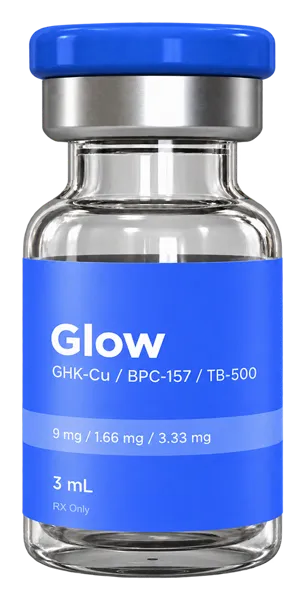
The best-known stack is the “glow” blend, which puts GHK-Cu in one vial with BPC-157 and TB-500. Our glow peptide explainer covers that blend ingredient by ingredient. This page stays with GHK-Cu itself and the question of route: skin or syringe.
Why are people injecting GHK-Cu instead of using a serum?
People are injecting GHK-Cu mainly because of a reasonable-sounding idea: a peptide that struggles to get through the skin might do more if it skips the skin barrier. Dr. David Goldberg, a cosmetic dermatologist quoted by NPR, said it is possible there are added benefits to injecting, partly because the molecule does not easily penetrate deeper into the skin when applied topically, while still advising patients to hold off until human studies are done (NPR, 2026). A 2025 review of topical GHK treats skin permeability as an open question: it notes formulation challenges from the peptide’s hydrophilic and unstable nature and reviews ways to push more of it through the skin, such as microneedles, while concluding that GHK-Cu is relatively skin permeable (Mortazavi et al., 2025).
The cultural side matters as much as the chemistry. NPR notes that GHK-Cu became a “beauty peptide” and a staple of looksmaxxing content, part of a broader peptide craze in wellness and longevity circles (NPR, 2026). A syringe also signals seriousness in a way a serum does not. Our read: the injection trend is built on a plausible mechanism question (does more reach the target?) that nobody has answered with a human study.
What does the research show for topical GHK-Cu?
Topical GHK-Cu has small human cosmetic studies behind it, which in words is modest, mostly industry-linked evidence. A 2015 review describes several studies in women around age 50, which it calls placebo-controlled: a 12-week facial cream study in 71 women with photoaging that reported better laxity, clarity and fewer fine lines; a 12-week eye cream study in 41 women where the GHK-Cu cream beat both a placebo and a vitamin K cream; a 12-week study in 67 women aged 50 to 59; and a one-month thigh-cream biopsy study in which collagen production rose in 70% of women using GHK-Cu, compared with 50% for vitamin C cream and 40% for retinoic acid (Pickart et al., 2015).
Three caveats keep that in proportion. The review’s authors work at Skin Biology, a copper-peptide skincare company, and NPR describes the controlled human studies as generally small trials funded by the cosmetic industry (NPR, 2026). An independent 2025 review went further, calling it a “surprising absence of clinical studies” for GHK-Cu and its palmitoylated cousin, given how widely they are sold in anti-wrinkle products (Mortazavi et al., 2025). And one small randomized study after CO2 laser resurfacing found no objective difference in redness, wrinkles or skin quality between GHK-Cu users and non-users, even though the GHK-Cu group reported higher satisfaction (Miller et al., 2006). For the full topical picture, see our guide to GHK-Cu copper peptides for skin.
What does the research show for injected GHK-Cu?
Injected GHK-Cu has no published human trials; the evidence level, in words, is animal studies only. A 2018 review by two of the same company-affiliated authors states that GHK-Cu given systemically to mice, rats and pigs had protective effects against cortisone-induced slowing of wound healing (Pickart and Margolina, 2018). Other animal work uses different routes entirely: a University of Washington group gave GHK-Cu intranasally to a mouse model of Alzheimer’s disease and reported less cognitive decline and fewer amyloid plaques (Tucker et al., 2023). None of that tells you what a subcutaneous dose does to a human face. PeptideAgent’s topical vs injectable GHK-Cu explainer comes to the same split: small skin studies for the topical form, and no human trial for the injectable one.
We searched PubMed on October 12, 2026. A filter for clinical or randomized trials of GHK-Cu returned only a few records, all of them topical products and none of them injection, and a search for GHK-Cu with injection, injectable or subcutaneous in the title or abstract returned six papers, none of them a human trial of injection. Several were materials-science studies of GHK-Cu loaded into injectable gels or fillers, such as a hydroxyapatite filler tested in lab and in vivo inflammation models (Hu et al., 2025). In that literature, “injectable” means a wound or filler material in development, not a self-injected peptide. A 2026 review for orthopaedic and sports-medicine physicians reached the same place: GHK-Cu showed promise in wound healing and anti-inflammatory effects, but no clinical data support its use for musculoskeletal conditions (Mayfield et al., 2026).
GHK-Cu topical vs injectable: how do they compare?
Topical and injectable GHK-Cu share a molecule but almost nothing else in their evidence base. This table sets them side by side; every row is sourced in the sections above and below.
| Question | Topical GHK-Cu (serum, cream) | Injectable GHK-Cu |
|---|---|---|
| How long it has been used | Decades as a cosmetic ingredient | A recent social-media trend |
| Human studies | Small placebo-controlled cosmetic studies, mostly industry-linked | None published |
| Evidence level, in words | Small human cosmetic studies (modest) | Animal studies only |
| Measured skin outcomes | Modest gains in firmness, fine lines, density in small trials; one small randomized study found no objective difference | None measured in people |
| Main known problems | None reported in cosmetic use, according to the company-affiliated 2015 review | Injection-site irritation and infection, raised liver enzymes and copper in some self-injectors (clinician report); possible immune reaction (FDA safety summary) |
| Product-quality question | Ordinary cosmetic products | Largely grey-market sourcing; mislabeling documented in grey-market peptide testing |
| What a clinician told NPR works better | Topicals, for skin and hair | Injection “tends to have minimal impact” in his experience |
The gap is not that injections are proven worse; it is that they have not been measured at all. One clinician NPR interviewed, a doctor of nursing practice who offers GHK-Cu as a serum, cream and occasionally an injection, said that in his clinical experience the topicals work much better for skin and hair growth and that injecting copper peptides tends to have minimal impact (NPR, 2026). That is one practitioner’s view, not a trial, but it is the closest thing to a comparison that exists.
What do GHK-Cu peptide injection before and after posts show?
GHK-Cu peptide injection before and after posts show what individual users chose to photograph, not a measured result, because no study has measured skin outcomes after injection. The only measured outcomes for GHK-Cu on skin come from the topical studies above: modest changes in firmness, fine lines and skin density in 12-week facial studies of small groups of women (Pickart et al., 2015). We do not show or summarize before-and-after photos as evidence.
The laser study is the most useful lens for reading these posts. People using GHK-Cu products were significantly more satisfied with their skin, but blinded evaluators and computer analysis found no measurable difference from the comparison group (Miller et al., 2006). Feeling better about your skin is a real outcome; it is just not the same as a change a stranger could measure. Lighting, angle, filters, hydration and any other routine change made in the same weeks also travel with every photo, and people with a dramatic change are the ones most likely to post.
Is GHK-Cu safe to inject?
Nobody can say how safe GHK-Cu is to inject, because its side effects have never been measured in a published human trial. What exists are warnings and reports. FDA’s safety summary for injectable GHK-Cu says compounded injectable versions may pose a risk of immunogenicity (an immune response) due to aggregation and peptide-related impurities, and that there are limited human data to inform safety (FDA).
From the clinic side, the same clinician told NPR that most of his GHK-Cu consults are with people who bought it online and injected it themselves, and that the problems he sees range from injection-site irritation and infections to elevated liver enzymes and raised copper levels in people injecting too much without lab work; NPR notes it is unclear whether the copper peptide or undisclosed substances or impurities were responsible (NPR, 2026). Dr. Warren Ladiges, a University of Washington researcher who has studied GHK for years, told NPR the peptide looks well tolerated in animal studies but said he would not inject it himself without knowing what it will do; NPR lists overloading the body with copper and triggering a dangerous immune reaction among the potential risks of injection. A 2026 Sports Medicine review covering GHK-Cu among other unapproved peptides concluded that rigorous human safety data are scarce and there is potential for serious harm (Mendias and Awan, 2026). Our page on whether GHK-Cu is safe covers the topical record, copper allergy and the sleep stories in more detail.
What are people saying about GHK-Cu injections?
Online, injected GHK-Cu shows up mostly as one line item in bigger peptide stacks rather than as a topic of its own. Our community tracker has no dedicated GHK-Cu dataset yet, but the copper peptide appears in X posts we collected in July 2026 for other peptides:
- Stacked, not solo. In 19 MOTS-c posts collected July 16 to 19, 2026, users described combining MOTS-c with items such as NAD+, GHK-Cu and GLP peptides. In 8 KPV posts collected July 18 to 20, 2026, users described stacking KPV with BPC-157, TB-500 and GHK.
- A reaction, and a workaround. In 13 thymosin alpha-1 posts collected July 9 to 16, 2026, one user said mixing thymosin alpha-1 with GHK-Cu eliminated her histamine response to GHK-Cu, while another listed thymosin alpha-1 among peptides they consider incompatible for co-mixing.
Our read: the conversation is about what to combine GHK-Cu with, not about measured skin results, and stacking several injectables at once makes it harder for anyone to tell which one did what. These are a small number of unverified self-reports from a few days of posts. The press picture fills in the rest: dermatologists told NPR they are advising patients to hold off on injecting anything, and Goldberg said he will not sleep well “until the human studies are actually done” (NPR, 2026).
Where do people get GHK-Cu peptide injections?
People get injectable GHK-Cu from two main places, and they carry different risks. NPR reports that many buy injectable formulations from a grey market of online sellers, which is where much of the worry centers, since there is no assurance about quality or dosage; Dr. Marisa Garshick, a dermatologist, told NPR that whether such a product is even a copper peptide is always a concern, and that the stakes are higher when you inject (NPR, 2026). Some clinicians also offer it: the doctor of nursing practice NPR interviewed occasionally injects it, usually mixed with other peptides, and said he buys his from a licensed U.S. compounding pharmacy.
Product testing explains why sourcing matters. TIME reported that at least 20% of the unapproved peptides tested since the previous October by the drug-testing company BTLabs were mislabeled, and its co-founder gave the example of a vial labeled Glow that was actually Klow, or the other way round (TIME, 2026); the two blends are compared in KLOW vs Glow. One retailer, Bodybuilding Peptides, does not list GHK-Cu as a standalone product; it appears only inside its Glow Blend with BPC-157 and TB-500 (product listing, checked October 12, 2026). On cost, the price of a vial is only part of the picture: the clinician NPR spoke to tied the worst outcomes he sees to people injecting without lab work, a cost and a step the self-injectors he described had skipped.
Status (injectable GHK-Cu): Not FDA-approved; sold by some telehealth providers as a compounded prescription. What these status terms mean.
The bottom line on GHK-Cu injections
The GHK-Cu glow trend moved from serums to syringes on the strength of a mechanism question, not a study. Topical GHK-Cu has small, mostly industry-linked human studies showing modest cosmetic gains, plus one small randomized study that found no objective difference. Injected GHK-Cu has animal studies, an FDA immunogenicity warning, clinician reports of liver and copper problems in self-injectors, and documented mislabeling among grey-market peptides. Before-and-after posts sit on top of that gap rather than closing it. If the goal is skin, the route with human data is the topical one; for the wider picture of the molecule, see the GHK-Cu overview on The Treatment Report.
Sources and further reading
- Pickart L, Vasquez-Soltero JM, Margolina A. GHK Peptide as a Natural Modulator of Multiple Cellular Pathways in Skin Regeneration. BioMed Research International, 2015;2015:648108
- Pickart L, Margolina A. Regenerative and Protective Actions of the GHK-Cu Peptide in the Light of the New Gene Data. Int J Mol Sci. 2018;19(7):1987
- Miller TR, et al. Effects of topical copper tripeptide complex on CO2 laser-resurfaced skin. Arch Facial Plast Surg. 2006;8(4):252-9
- Mortazavi SM, Mohammadi Vadoud SA, Moghimi HR. Topically applied GHK as an anti-wrinkle peptide: Advantages, problems and prospective. Bioimpacts. 2025;15:30071
- Mayfield CK, et al. Injectable Peptide Therapy: A Primer for Orthopaedic and Sports Medicine Physicians. Am J Sports Med. 2026;54(1):223-229
- Mendias CL, Awan TM. Safety and Efficacy of Approved and Unapproved Peptide Therapies for Musculoskeletal Injuries and Athletic Performance. Sports Med. 2026;56(8):1921-1935
- Hu D, et al. An injectable hydroxyapatite microsphere filler loaded with GHK-Cu tripeptide for anti-inflammatory and antioxidant. Colloids Surf B Biointerfaces. 2025;256:114982
- Tucker M, et al. Behavioral and neuropathological features of Alzheimer’s disease are attenuated in 5xFAD mice treated with intranasal GHK peptide. bioRxiv preprint, 2023
- U.S. Food and Drug Administration. Certain Bulk Drug Substances for Use in Compounding that May Present Significant Safety Risks (GHK-Cu, injectable routes)
- Stone W. The copper peptide trend has gone from creams to injections, ahead of the science. NPR, September 7, 2026
- Mosbergen D. What to Know About the “Anti-Aging” Peptide Shots Flooding Social Media. TIME, February 24, 2026
Educational information only, not medical advice. Community observations come from our July 2026 X post collections for MOTS-c, KPV and thymosin alpha-1. PubMed searches run October 12, 2026. Updated October 12, 2026.
Advertising disclosure: links marked "Paid link" go to Bodybuilding Peptides (trybbpeptides.com), an affiliate destination, and Complexion Science may earn a commission if you buy there. Our coverage is independent of that relationship, and nothing on this page is medical or legal advice.
 See it at Bodybuilding Peptides