What is the glow peptide? The GHK-Cu, BPC-157 and TB-500 blend, explained
The short answer
The glow peptide is an injectable blend of three peptides: GHK-Cu, a copper peptide with small human studies only as a skin cream, plus BPC-157 and TB-500, recovery peptides studied mostly in animals. No published study has tested the three together, and before-and-after posts are unverified self-reports.
The glow peptide is the rare skincare trend that does not come in a jar. Scroll skincare TikTok or Instagram long enough and you will see it called the glow blend, the glow stack or just “Glow”: a single injectable vial holding three peptides, GHK-Cu, BPC-157 and TB-500, sold on the promise of firmer, clearer, better-healing skin. This page is a plain-language explainer and a bit of social commentary. It covers what is actually in the blend, why it took off, what the research shows for each of the three ingredients (with the strength of that evidence stated in words), the side effects clinicians are reporting, how it compares with a regular copper-peptide serum and with the “Wolverine” recovery stack, what it costs, and what all those before-and-after posts can and cannot tell you. It is educational only, not medical advice, and it does not tell anyone how to use the product.
What is the glow peptide?
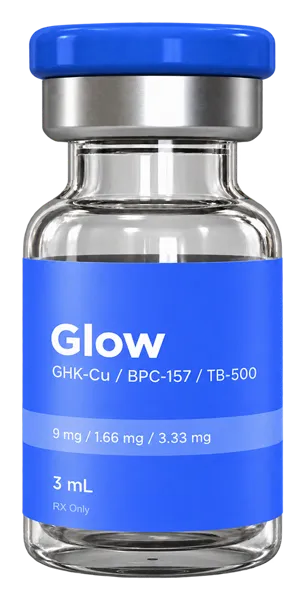
The glow peptide is a product name for an injectable blend of three separate peptides, not a single new molecule. The three are GHK-Cu, a small copper-binding peptide best known from skincare; BPC-157, a lab-made peptide originally derived from a protein in gastric juice; and TB-500, a short synthetic fragment of a natural protein called thymosin beta-4. Sellers and influencers pitch the combination as a skin-and-repair stack: copper peptide for collagen and “glow,” the two recovery peptides for healing.
Because “Glow” is a brand-style label rather than a defined drug, there is no official recipe behind the word, and nothing guarantees that two vials sold under the name contain the same thing. That is not a hypothetical worry. TIME reported in February 2026 that a drug-testing company, BTLabs, found at least 20% of the unapproved peptides it had tested since the previous October were mislabeled, and its co-founder described vials labeled “Glow” that turned out to be a different blend called Klow, or the other way round (TIME, 2026); we compare the two blends part by part in KLOW vs Glow. If you want the background on the copper-peptide part on its own, our guide to GHK-Cu copper peptides for skin goes deeper.
What’s in glow peptide?
Glow peptide contains three active peptides: GHK-Cu, BPC-157 and TB-500. One retailer, Bodybuilding Peptides, describes its Glow Blend as an injectable that combines exactly those three in a single 3 mL vial (product listing, checked October 12, 2026). Each component has a very different backstory and a very different amount of evidence behind it, which is the most useful thing to understand about the blend.
| Component | What it is | Where most of the evidence comes from | Evidence level, in words |
|---|---|---|---|
| GHK-Cu | A three-amino-acid peptide bound to copper, found naturally in human plasma; levels fall with age | Cell and animal work, plus small human studies of creams applied to the skin | Small human cosmetic studies (topical only); no human studies of injection |
| BPC-157 | A synthetic 15-amino-acid peptide first isolated from gastric juice | Rat and other animal studies; three small human pilot studies | Mostly animal studies; human data limited to tiny pilot studies |
| TB-500 | A synthetic fragment of thymosin beta-4; a doping lab identified the acetylated 17 to 23 fragment in a product sold as TB-500 | The human trials we found are for the full-length thymosin beta-4 protein, used topically on wounds or as an eye drop | No human trials of the fragment itself; parent protein has small topical trials |
| The blend | All three combined in one injectable vial | Nothing published | Untested as a combination |
Sources for each row are in the sections below: Pickart et al., 2015; Vasireddi et al., 2025; McGuire et al., 2025; Esposito et al., 2012.
Why is the glow peptide trending?
The glow peptide is trending because it sits where three bigger stories meet: the injectable-peptide boom, the copper-peptide skincare craze, and the “glow up” culture of short-form video. NPR described the GHK-Cu side of this in September 2026 as a trend that “has gone from creams to injections,” noting that injected copper peptide is sometimes “stacked” with other peptides promoted for tissue repair (NPR, 2026). TIME reported that people on social media experiment with stacks that carry names like “Wolverine” and with blends, meaning several peptides mixed in the same vial (TIME, 2026).
The Guardian’s April 2026 column on the trend captured the pitch in a phrase: influencers sell injectable peptides as a “glow up potion” for everything from hormonal acne to thinning hair (The Guardian, 2026). Put a recognizable skincare ingredient next to two peptides already famous in gym circles, give it a one-word name, and you get a product that travels well on a phone screen. What travels less well is the evidence, which is where the rest of this page goes.
What does the research show for GHK-Cu?
GHK-Cu has the best human evidence of the three ingredients, but all of that human evidence is for creams and serums on the skin, not for injections. A 2015 review describes several placebo-controlled cosmetic studies in women around age 50: a 12-week facial cream study in 71 women with signs of photoaging that reported better firmness, clarity and fewer fine lines; a 12-week eye-cream study in 41 women where the copper-peptide cream beat both a placebo and a vitamin K cream; and a thigh-biopsy study in which collagen production rose in 70% of women using GHK-Cu cream, compared with 50% for a vitamin C cream and 40% for retinoic acid (Pickart et al., 2015). The same review notes that GHK in human plasma falls from about 200 ng/mL at age 20 to about 80 ng/mL by age 60, which is the origin of the “you lose it as you age” line in so many videos.
Two honest caveats belong next to those results. First, the review’s authors work at Skin Biology, a company in the copper-peptide skincare business, and NPR describes the controlled human studies as generally small trials funded by the cosmetic industry (NPR, 2026), so independent replication matters. Second, at least one independent randomized study came out less rosy, although it was tiny (13 patients completed it): after CO2 laser resurfacing, blinded evaluators and computer analysis found no difference in redness, wrinkles or overall skin quality between people using GHK-Cu products and those who did not, even though the GHK-Cu users reported being more satisfied (Miller et al., 2006).
For the injected form, the evidence thins to almost nothing. A 2018 review notes that studies of GHK-Cu given systemically were done in animals such as mice, rats and pigs (Pickart and Margolina, 2018). A PubMed search we ran on October 12, 2026, for clinical or randomized trials of injected or subcutaneous GHK-Cu found none. Our page on whether GHK-Cu is safe covers the topical safety record in more detail.
What does the research show for BPC-157?
BPC-157’s evidence is mostly animal studies, with only a handful of tiny human reports. A 2025 systematic review from an orthopaedic sports-medicine group found 36 eligible studies, of which 35 were preclinical and one was clinical; in animal models BPC-157 improved healing of muscle, tendon, ligament and bone, but the authors found no clinical safety data in humans (Vasireddi et al., 2025). A separate 2025 narrative review counted three small human pilot studies in total (knee pain, interstitial cystitis, and intravenous safety) and concluded that BPC-157 should be considered investigational until well-designed trials are done (McGuire et al., 2025).
The human data that do exist are very small. One retrospective chart review from a single Florida clinic phoned 16 patients who had received knee injections of BPC-157, alone or with thymosin beta-4, and reported that most said their pain improved; there was no control group and no standard outcome measure (Lee and Padgett, 2021). An intravenous safety pilot enrolled two people, both of whom had used BPC-157 before, and reported no changes in the blood markers it tested (Lee and Burgess, 2025).
What about skin, the whole point of a “glow” product? The skin-healing claims come from rat work. A 2020 review from a University of Zagreb research group describes it healing skin wounds, fistulas and other injuries in rats (Sikiric et al., 2020). We found no human study of BPC-157 for skin appearance, wrinkles or complexion. For a fuller side-by-side of the two recovery peptides, see BPC-157 vs TB-500 on The Recovery Dose.
What does the research show for TB-500?
TB-500 has no published human trials of its own; the human data people cite belong to its parent protein. Thymosin beta-4 is a natural 43-amino-acid protein. Anti-doping chemists analyzing a product sold as TB-500 detected and identified a short acetylated fragment of that protein (amino acids 17 to 23) in it (Esposito et al., 2012).
The full-length protein has been tested in people, but as a topical treatment. A Phase 2 trial at eight European sites randomized 73 patients with venous leg ulcers to topical thymosin beta-4 or placebo; safety was comparable to placebo, and the authors reported that one dose “may have the potential” to speed healing (Guarnera et al., 2010). A Phase 2 dry-eye trial of thymosin beta-4 eye drops in 72 people missed both of its primary endpoints, although some secondary measures improved and no adverse events were reported (Sosne and Ousler, 2015).
So the honest summary is this: a topical wound treatment and an eye drop made from the full protein have small, mixed human trials, and the injected fragment sold as TB-500 has none. The skin-repair story attached to TB-500 in glow-blend marketing borrows from research on a different molecule, given a different way.
Has the glow blend been studied as a whole?
No. We found no published study of GHK-Cu combined with BPC-157 and TB-500, in people or in animals. A PubMed search on October 12, 2026, for papers mentioning glow, GHK and BPC together returned zero results, and searches for clinical or randomized trials of BPC-157 or TB-500 by name found none either. PeptideAgent’s GLOW blend profile reports the same gap, listing no published study of the combination in people or animals, and grades each ingredient on its own.
That matters because a blend adds questions of its own. Even with good data on each ingredient, combining them raises questions about interactions, stability in the same vial and overall exposure that nobody has measured. TIME quoted longevity expert Eric Topol making exactly this point: it is not clear how peptides taken together interact with one another (TIME, 2026). The logic of the stack (copper peptide for collagen, two repair peptides for healing) is a theory that has not been tested.
What are the claimed glow peptide benefits, and what does the evidence say?
The claimed glow peptide benefits are firmer skin, fewer fine lines, a brighter or clearer complexion, faster healing and sometimes thicker hair; none of these has been shown for the injectable blend. Some of the claims borrow from real but limited topical research, and others borrow from animal data. This table sorts the common claims by where they come from.
| Common claim | What the claim borrows from | What has actually been shown |
|---|---|---|
| Firmer skin, fewer fine lines | Small placebo-controlled cosmetic studies of GHK-Cu creams | Modest improvements with creams applied to the face; not tested for injection |
| More collagen | GHK-Cu cream biopsy study; cell studies | Collagen rose with a topical cream in a small study; no injection data |
| Faster healing, less scarring | Rat wound studies of BPC-157; topical venous ulcer trial of full-length thymosin beta-4 | Animal healing effects; one small, mixed human topical trial of a different molecule |
| Clearer skin, less acne | Influencer posts, as described in press coverage | No clinical study of the blend or its parts for acne that we found |
| Thicker hair | GHK-Cu hair research and influencer posts | No study of the injectable blend for hair; see our copper peptides and hair page |
The pattern is that the skin benefits most often promised are the ones with the thinnest connection to an injected product. Topical copper peptides are a reasonable cosmetic ingredient with modest evidence; that evidence does not transfer automatically to a syringe.
What are the side effects of the glow peptide?
The side effects of the glow peptide have not been measured in any trial, so what is known comes from clinician reports, case anecdotes and the general risks of unregulated injectables. A doctor of nursing practice who runs a wellness clinic told NPR that the problems he sees in people who injected grey-market GHK-Cu on their own range from injection-site irritation and infections to more serious problems affecting the liver, including patients with elevated liver enzymes and raised copper levels who had been injecting too much without checking lab work; NPR notes it is unclear whether the copper peptide or undisclosed substances or impurities were responsible. Dermatologists told NPR they advise patients to hold off on injecting (NPR, 2026). In the same piece, a University of Washington researcher who has studied GHK for years said he would not inject it himself without knowing what it will do.
On the BPC-157 side, the 2025 systematic review found no clinical safety data and warned that adverse effects are possible from unregulated manufacturing, contamination or unknown clinical safety (Vasireddi et al., 2025). TIME quoted a rehabilitation clinician-scientist describing a patient who “started peeing blood” after taking BPC-157, an individual case rather than a measured rate (TIME, 2026). Add the mislabeling problem described above, and the biggest practical risk may simply be not knowing what is in the vial.
Nobody has studied the blend in pregnancy or breastfeeding, or in people with liver or kidney disease, and the liver-enzyme and copper findings NPR reported are a reason for extra caution there. Anyone who competes in tested sport should also know that BPC-157 is banned in professional sports, as the 2025 systematic review notes (Vasireddi et al., 2025). None of that is a dosing instruction; these are situations where a conversation with a clinician should come first.
How does the glow blend compare with topical copper peptides and the Wolverine stack?
The glow blend is essentially a recovery stack with a copper peptide added, and it is a very different proposition from a copper-peptide serum. On Bodybuilding Peptides’ own listings, checked October 12, 2026, Glow Blend’s BPC-157 and TB-500 strengths per mL match those of its Wolverine Blend (BPC-157 and TB-500 only); the difference is the added GHK-Cu.
| Option | What it contains | How it is used | Best evidence, in words | Price point (where we have one) |
|---|---|---|---|---|
| Topical GHK-Cu serum or cream | GHK-Cu | Applied to the skin | Small human cosmetic studies, some industry-run | Sold at ordinary skincare prices; varies by brand |
| Wolverine stack | BPC-157 + TB-500 | Injected | Mostly animal studies; no human trials of the pair (one chart review had 4 patients on BPC-157 plus full thymosin beta-4) | $220 for a one-month plan at Bodybuilding Peptides (checked Oct 12, 2026) |
| Glow blend | GHK-Cu + BPC-157 + TB-500 | Injected | Untested as a blend; each part mostly preclinical when injected | $353 for a one-month plan at Bodybuilding Peptides (checked Oct 12, 2026) |
If your goal is skin rather than injury recovery, the topical route is the one with human data behind it, and our explainer on GHK-Cu peptide injections covers what is and is not known about injecting the copper peptide on its own. Our explainer on prescription-grade skin peptides walks through the difference between cosmetic serums, “research use only” vials and the injectable form.
What do glow peptide before and after posts show?
Glow peptide before and after posts show what individual users chose to photograph and share, which is not the same as evidence that the blend works. We do not have a dataset of these posts, and we are not going to summarize them as if they were results. What we can do is explain why they are hard to read.
A before-and-after photo bundles together lighting, camera angle, distance, makeup, filters, hydration, time of day and whatever else changed in the person’s routine over the same weeks, such as a new retinoid, more sleep or a recent facial. Posts are also self-selected: people with a dramatic change post, and people with no change mostly do not. And feeling better about your skin is a real but separate outcome from measurable change. The CO2 laser study above is a neat illustration: people using GHK-Cu products were more satisfied with their skin, but blinded evaluators and computer analysis found no measurable difference (Miller et al., 2006). If a glow-peptide post moves you, ask what else changed, and whether the improvement would survive a blinded comparison.
What are people saying about the glow stack?
Online, the glow stack shows up less as a standalone topic and more as one combination inside a bigger peptide conversation. Our community tracker does not yet have a dedicated glow-blend dataset, but its three ingredients appear in the X posts we collected in July 2026:
- The pairing is the default. In 16 TB-500 posts collected July 14 to 19, 2026, many users described TB-500 and BPC-157 as a paired stack, with TB-500 framed as the recovery component.
- Not everyone is sold on blends. In the same TB-500 set, one commenter said they had stopped buying blended vials and preferred BPC-157 alone, and another said they were not convinced by the BPC-157 and TB-500 combination.
- “Is it even TB-500?” Several TB-500 posters stressed that TB-500 is a fragment, not the full thymosin beta-4 protein, and one claimed most products sold as TB-500 actually contain the full chain. That claim is unverified, but it echoes the mislabeling findings TIME reported.
- Skin use of BPC-157 is fringe. In 15 BPC-157 posts from July 16 to 20, 2026, a few users described applying BPC-157 topically for skin or scalp oiliness; these were isolated single accounts with no consensus.
- GHK-Cu as a line item. GHK-Cu appeared in stacks discussed in 19 MOTS-c posts (July 16 to 19, 2026), GHK turned up in KPV stacks in 8 KPV posts (July 18 to 20, 2026), and in 13 thymosin alpha-1 posts (July 9 to 16, 2026) one user said mixing TA1 with GHK-Cu eliminated her histamine reaction to GHK-Cu, while another listed TA1 among peptides they would not co-mix.
These are a small number of self-reports, collected over a few days, with no way to verify them. They show what people are trying and arguing about, not whether the glow stack works. For a broader overview of each ingredient, the hub monographs on GHK-Cu, BPC-157 and TB-500 collect the research in one place.
How much does the glow peptide cost?
As one dated reference point, Bodybuilding Peptides listed its Glow Blend at $353 for a one-month plan when we checked on October 12, 2026, with no three-month plan shown. Its Wolverine Blend, the same BPC-157 and TB-500 pairing without the copper peptide, was listed at $220 for one month, so on that store the GHK-Cu component accounts for the price gap. Topical copper-peptide serums are mainstream cosmetics sold at ordinary skincare prices.
Prices change, so treat these as a snapshot rather than a quote. Cost is also only one part of the decision: a cheaper vial of uncertain contents is not a bargain if you cannot verify what is in it.
The bottom line on the glow peptide
The glow peptide is a social-media product built from one ingredient with modest topical skin evidence and two recovery peptides with mostly animal evidence, combined in a form, injection, that none of the human skin studies tested. No study has examined the blend itself, side effects have not been measured, and mislabeling is a documented problem in this market. The before-and-after posts driving the trend are real experiences, but they are not controlled comparisons. If your goal is firmer, clearer skin, the evidence points first to topicals you can read about in our GHK-Cu skin guide, and to a clinician if you are weighing anything you would inject.
Status: Not FDA-approved; sold by some telehealth providers as a compounded prescription. An FDA advisory committee reportedly voted in July 2026 to recommend allowing pharmacies to compound it; nothing has changed yet. This applies to BPC-157 and TB-500; injectable GHK-Cu is also not FDA-approved. What these status terms mean.
Sources and further reading
- Pickart L, Vasquez-Soltero JM, Margolina A. GHK Peptide as a Natural Modulator of Multiple Cellular Pathways in Skin Regeneration. BioMed Research International, 2015;2015:648108
- Pickart L, Margolina A. Regenerative and Protective Actions of the GHK-Cu Peptide in the Light of the New Gene Data. Int. J. Mol. Sci. 2018;19(7):1987
- Miller TR, et al. Effects of topical copper tripeptide complex on CO2 laser-resurfaced skin. Arch Facial Plast Surg. 2006;8(4):252-9
- Vasireddi N, et al. Emerging Use of BPC-157 in Orthopaedic Sports Medicine: A Systematic Review. HSS J. 2025;21(4):485-495
- McGuire FP, et al. Regeneration or Risk? A Narrative Review of BPC-157 for Musculoskeletal Healing. Curr Rev Musculoskelet Med. 2025;18(12):611-619
- Lee E, Padgett B. Intra-Articular Injection of BPC 157 for Multiple Types of Knee Pain. Altern Ther Health Med. 2021;27(4):8-13
- Lee E, Burgess K. Safety of Intravenous Infusion of BPC157 in Humans: A Pilot Study. Altern Ther Health Med. 2025;31(5):20-24
- Sikiric P, et al. Fistulas Healing. Stable Gastric Pentadecapeptide BPC 157 Therapy. Curr Pharm Des. 2020;26(25):2991-3000
- Esposito S, et al. Synthesis and characterization of the N-terminal acetylated 17-23 fragment of thymosin beta 4 identified in TB-500. Drug Test Anal. 2012;4(9):733-8
- Guarnera G, et al. The effect of thymosin treatment of venous ulcers. Ann N Y Acad Sci. 2010;1194:207-12
- Sosne G, Ousler GW. Thymosin beta 4 ophthalmic solution for dry eye: a randomized, placebo-controlled, Phase II clinical trial. Clin Ophthalmol. 2015;9:877-84
- Stone W. The copper peptide trend has gone from creams to injections, ahead of the science. NPR, September 7, 2026
- Mosbergen D. What to Know About the “Anti-Aging” Peptide Shots Flooding Social Media. TIME, February 24, 2026
- May N. Injectable peptides are touted online as a “glow up potion”. The Guardian, April 1, 2026
Educational information only, not medical advice. Community observations come from our July 2026 X post collections for BPC-157, TB-500, MOTS-c, KPV and thymosin alpha-1. Updated October 12, 2026.
Advertising disclosure: links marked "Paid link" go to Bodybuilding Peptides (trybbpeptides.com), an affiliate destination, and Complexion Science may earn a commission if you buy there. Our coverage is independent of that relationship, and nothing on this page is medical or legal advice.
 See it at Bodybuilding Peptides