'Prescription-grade' skin peptides: what the label means, and what each form actually offers
The short answer
"Prescription-grade" is a marketing phrase, not an official quality rating. Skin-peptide shoppers really choose between three forms. Topical copper-peptide (GHK-Cu) creams and serums are the best studied: small human trials report modest gains in the look of firmness, fine lines and clarity. "Research use only" vials are labeled not for human use, and their contents are hard to verify. Injectable GHK-Cu has animal data but no published human trials, so its benefits and side effects in people are largely unmeasured.
If you have searched for “prescription-grade skin peptides,” you are probably looking for something stronger and more serious than an ordinary serum. It helps to know up front that the phrase itself is doing a lot of quiet work. There is no official grade called “prescription-grade,” and the label does not tell you a product is more effective, purer, or better studied. What a skin-peptide shopper actually chooses between is three different forms: a copper-peptide (GHK-Cu) cream or serum, a “research use only” vial, and injectable GHK-Cu. This page walks through what each one is, how people use it, how strong the evidence is, and what to check before you trust the label.
What does “prescription-grade skin peptides” actually mean?
“Prescription-grade,” “pharmaceutical-grade,” and “research-grade” are marketing descriptors, not quality ratings you can buy. The closest thing to a real, enforceable purity standard is a USP monograph: the U.S. Pharmacopeia sets identity, strength, and purity specifications that are recognized in federal law, and the FDA, not USP, enforces them, so a product that claims to conform to a USP monograph but does not can be treated as adulterated or misbranded (USP, Legal Recognition of Standards). The catch for peptides specifically is that the popular skin and wellness peptides generally have no USP monograph at all, as ProPublica put it, “those peptides aren’t components of an approved drug and don’t carry a USP monograph” (ProPublica, 2026). So when a vendor stamps “pharmaceutical-grade” on a peptide, there is usually no official monograph behind the word. Treat it as a claim to check, not a certification to trust.
Form 1: topical copper-peptide (GHK-Cu) creams and serums
Topical GHK-Cu is the form with the most human evidence for skin, and it is sold over the counter as a cosmetic. GHK-Cu is the copper tripeptide glycine-histidine-lysine bound to a copper ion, and people use it in serums and creams for the look of firmness, fine lines, and clarity. In the lab it signals skin fibroblasts to build collagen and remodel the skin matrix (Pickart, Vasquez-Soltero & Margolina, 2015). In people, the evidence is small human trials of creams: one 12-week study in 71 women with photoaged skin reported increased skin density and thickness, reduced laxity, improved clarity, and fewer fine lines (Pickart & Margolina, 2018). We cover that evidence, and how strong it really is, in our guide on GHK-Cu copper peptides for skin.
On side effects, topical copper peptides are generally described as gentle, and the same review notes decades of cosmetic use without reported adverse effects; the usual cautions are local irritation and patch-testing first, which we cover in is GHK-Cu safe. Because these are cosmetics, they are not reviewed by the FDA before sale, and what keeps them cosmetics is that they claim to improve the appearance of skin rather than to treat a condition (FDA, “FDA Authority Over Cosmetics”; Congressional Research Service, MoCRA overview). The honest frame: a gentle, well-tolerated active with promising but limited human evidence, not a miracle.
Form 2: “research use only” peptide vials sold online
These are the vials that most often lean on “prescription-grade” and “pharmaceutical-grade” language, and they are the hardest form to judge. A market of online sellers offers peptide vials labeled “research chemicals,” “research use only,” or “not for human consumption,” while their own product pages pitch skin, anti-aging, and other human benefits (PolitiFact, March 2026). The disclaimer is the tell, not the safeguard.
The practical problem is that you often cannot know what is actually in a research-grade vial: strength and purity vary, manufacturing can introduce impurities such as bacteria or heavy metals, and peptides can degrade or change composition if stored or handled wrong (ProPublica, 2026; PolitiFact, 2026). “Prescription-grade” on that vial is a word, not a guarantee, and a product sold as not for human use gives you no basis for knowing what you are putting on or in your body.
Form 3: injectable GHK-Cu, what is and is not known
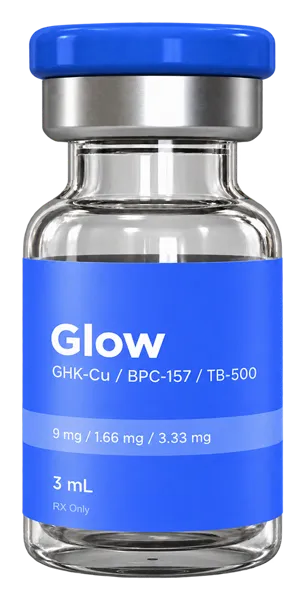
Injectable GHK-Cu is the form many people picture when they type “prescription-grade,” and it is the one with the least human evidence. The appeal is easy to understand: if a cream gets a small amount of copper peptide through the skin’s outer layer, injecting it sounds like a stronger dose of the same idea. The research does not yet support that leap. The human skin results described in the main reviews all come from creams and other products applied to the skin, while the studies of GHK-Cu given systemically or by injection were done in animals such as mice, rats and pigs (Pickart & Margolina, 2018). A PubMed search we ran on October 12, 2026, filtered to clinical and randomized trials of injected GHK-Cu in people, returned no results. Online, the injectable also appears inside the “glow” blend with BPC-157 and TB-500, covered in our glow peptide explainer.
That gap matters for both sides of the ledger. On benefits, there are no measured results in people for injected GHK-Cu on skin, so before-and-after claims are anecdotes, not trial outcomes. On side effects, the long, uneventful record of topical cosmetic use does not transfer to an injection, and what circulates online, such as stories of poor sleep or restlessness, comes from forum reports rather than measured rates. If you are weighing the injectable, treat it as a separate decision with its own unknowns, and talk it through with a clinician who knows your history. For a side-by-side of the topical and prescribed routes, see topical vs prescribed skin peptides, and for the injection trend on its own, our explainer on GHK-Cu peptide injections.
How do the three forms compare?
The three forms differ less in “grade” than in what they are, how much human evidence sits behind them, and how easily you can verify what you are getting.
| Form | What it is | Human evidence for skin (in words) | Main concern |
|---|---|---|---|
| Topical GHK-Cu cream or serum | Over-the-counter cosmetic | Small human trials of creams | Modest, appearance-level results; occasional local irritation |
| ”Research use only” vial | Labeled not for human use | None for the vial itself; contents often unverified | Unknown strength and purity; possible contaminants |
| Injectable GHK-Cu | Injected copper peptide | No published human trials; animal studies only | Benefits and side effects in people largely unmeasured |
How do you judge quality, whichever form you are looking at?
Start with the label and the claims rather than the grade. A well-made topical copper-peptide product states its ingredients clearly and makes appearance-level (cosmetic) claims rather than disease or “structure/function” promises. Be skeptical of any label leaning on “prescription-grade” or “pharmaceutical-grade” as if it were a certification, because, as covered above, for peptides there is usually no monograph behind those words. For anything sold as a vial, the questions are who made it, how it was stored, and whether there is any independent evidence of what is inside, which is exactly where the research-use market falls short (ProPublica, 2026).
Then match the form to the goal. For the look of firmness and fine lines, a topical copper peptide used consistently over months is the option with human data, and the best-evidenced anti-aging active overall is still a retinoid, which we compare in copper peptides vs retinol.
What can a goal-based skin consult actually do?
A consult is about matching your skin goals to sensible options, not a promise of any particular product or prescription. A licensed provider can look at your skin, your history, and what you already use, then talk through whether a topical copper peptide is a reasonable add, whether a prescription-strength treatment such as a retinoid fits your goals better, and what to skip. Whether any prescription is appropriate is a clinical judgment the provider makes with you; no legitimate service guarantees one in advance.
The bottom line
There is no official “prescription-grade” you can add to cart. For skin, the forms that actually exist are a topical copper peptide (GHK-Cu) with small but real human evidence for the look of aging skin; “research use only” vials whose contents are hard to verify; and injectable GHK-Cu, which has animal data but no published human trials. Judge each one by its evidence and how much you can verify, not by the word on the label. Copper peptides also come up in the hair conversation, which we cover in our guide to GHK-Cu for hair.
Status (injectable GHK-Cu): Not FDA-approved; sold by some telehealth providers as a compounded prescription. What these status terms mean.
Sources and further reading
Every quality, evidence, and product-category statement on this page traces to a primary or reputable source, listed here so you can verify it directly.
- U.S. Pharmacopeia. Legal Recognition, Standards Categories
- ProPublica. An FDA Reversal on Peptides Could Open the Market to Unsafe Drugs, 2026
- PolitiFact. What are peptides, and are they safe? March 6, 2026
- Pickart L, Vasquez-Soltero JM, Margolina A. GHK Peptide as a Natural Modulator of Multiple Cellular Pathways in Skin Regeneration. BioMed Research International, 2015
- Pickart L, Margolina A. Regenerative and Protective Actions of the GHK-Cu Peptide in the Light of the New Gene Data. Int. J. Mol. Sci. 2018;19(7):1987
- Congressional Research Service. FDA Regulation of Cosmetics Under MoCRA (2022). Report R47826
- U.S. Food & Drug Administration. FDA Authority Over Cosmetics (how cosmetics are regulated but not reviewed before sale)
Advertising disclosure: links marked "Paid link" go to Bodybuilding Peptides (trybbpeptides.com), an affiliate destination, and Complexion Science may earn a commission if you buy there. Our coverage is independent of that relationship, and nothing on this page is medical or legal advice.
 See it at Bodybuilding Peptides