How does an oral minoxidil prescription work online?

The short answer
Oral minoxidil is prescription-only in the US; only topical minoxidil is sold over the counter. Online, you complete a health questionnaire, often upload scalp photos, and a licensed clinician reviews it, usually without a live visit. If prescribed, a pharmacy ships tablets. A 2025 price comparison found online companies charged more per oral minoxidil tablet than retail pharmacies.
Oral minoxidil became a mainstream hair-loss topic after a 2022 newspaper story, and most of the people now asking about it want to know one practical thing: how do you actually get it? The short version is that the tablet needs a prescription, and online direct-to-consumer services that write those prescriptions have, in the words of one dermatology journal letter, “rapidly grown in prominence” (Jean-Pierre and Williams, JAAD 2025). This page walks through how that process works in practice, from the intake questionnaire to the box on your doorstep, what the research says about the drug itself (with the strength of that evidence stated in words), the side effects worth knowing, how online prices compare with a regular pharmacy, and what patients and researchers say about the experience. It is an editorial explainer, not a recommendation, and it does not tell anyone what dose to take.
Is oral minoxidil over the counter?
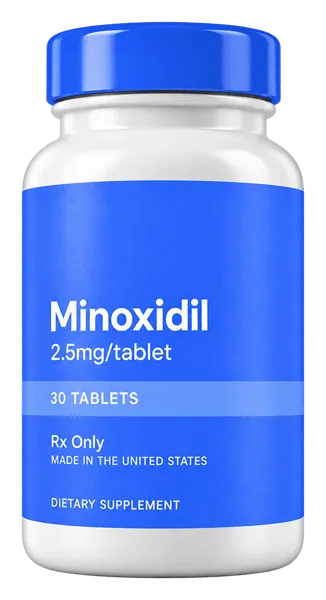
No. Oral minoxidil is a prescription-only tablet in the US; the minoxidil you can buy off the shelf is topical, such as the 5% solution. The tablet’s official label marks it “Rx only,” lists 2.5 mg and 10 mg strengths, and limits it to one use: high blood pressure that causes symptoms or organ damage and is not controlled by maximum doses of a diuretic plus two other blood pressure drugs (DailyMed, minoxidil tablets label). Using it for hair loss is off-label, meaning a clinician can prescribe it for that purpose but the label does not cover it.
Topical minoxidil is different. A 5% solution is sold over the counter under a standard Drug Facts label as a “hair regrowth treatment for men,” with instructions to stop and ask a doctor if chest pain, a rapid heartbeat, dizziness, sudden weight gain or swollen hands or feet occur (DailyMed, minoxidil 5% topical solution). So “minoxidil” in a pharmacy aisle and “oral minoxidil” from a telehealth app are the same active ingredient in two different regulatory lanes.
How do you get oral minoxidil?
You get oral minoxidil through a licensed prescriber, either in person (a dermatologist or primary care clinician) or through an online telehealth service. A 2025 letter in the Journal of the American Academy of Dermatology put the trend plainly: direct-to-consumer companies let patients access oral minoxidil and finasteride while “bypassing traditional physician consultations” (Jean-Pierre and Williams, JAAD 2025). The online route usually follows the same five steps, summarized here and expanded below.
| Step | What typically happens online | What it replaces in a clinic |
|---|---|---|
| 1. Intake | A health questionnaire on medical history, medications and the pattern of hair loss | The history taken at a first appointment |
| 2. Photos | Scalp photos uploaded from your phone | An in-person scalp exam, sometimes with a scope |
| 3. Review | A licensed clinician reviews the file, often asynchronously (no live call) | The face-to-face consultation |
| 4. Prescription | If appropriate, a prescription goes to a partner pharmacy | A prescription sent to a pharmacy you choose |
| 5. Delivery | Tablets are shipped, often on a recurring plan, with periodic photo or message check-ins | Picking up at a pharmacy; follow-up visits |
The details vary by company, and nothing in that sequence guarantees a prescription: the reviewing clinician can decline, ask for more information or suggest a different treatment.
What happens during an online intake and provider review?
Online review is mostly asynchronous: you submit answers and photos, and a clinician reviews them later rather than meeting you on video. A 2023 paper describing one large hair-loss platform (written by authors affiliated with the company that runs it) lays out the model clearly: the patient journey “starts via an asynchronous consultation with a physician, which includes scalp photos submitted by the patient,” followed by automated check-ins, a photo “progress tracker” the physician reviews, the option to message the physician, and “delivery of medications directly to the patient’s doorstep” (Young et al., Int J Dermatol 2023). That platform described prescribing finasteride and recommending over-the-counter topical minoxidil; the paper does not cover oral minoxidil, so read it as a description of the online model rather than of any oral minoxidil service. The same paper says patients are advised to seek an in-person dermatology visit when the diagnosis is in doubt.
The trade-off is the exam. The JAAD letter warns that these consultations “lack face-to-face clinician interactions,” and that without a proper hair inspection by a dermatologist, “the alopecia type may be improperly diagnosed, leading to inappropriate treatment and possible side effects” (Jean-Pierre and Williams, JAAD 2025). Because oral minoxidil is a blood pressure drug, the intake questions that line up with its label warnings are about heart conditions, kidney problems, other medications, and pregnancy or breastfeeding. If a form does not ask about those, treat that as information about the service.
Our sister site The ED Report covers the same model for erectile dysfunction in its guide to getting ED treatment online safely, and Peptides in Review explains how the pharmacy side works when a drug is made to order in how compounded peptide prescribing works.
What does the research show about oral minoxidil for hair loss?
The evidence for oral minoxidil in hair loss is a mix of one small head-to-head randomized trial and larger observational studies; there is no large trial comparing it with an inactive placebo. The best-controlled study is a 2024 double-blind trial at a single clinic in Brazil that randomized 90 men with pattern hair loss to oral minoxidil 5 mg once a day or topical minoxidil 5% twice a day for 24 weeks, each group also using a placebo of the other form (Penha et al., JAMA Dermatol 2024). After 24 weeks, oral minoxidil “did not demonstrate superiority” over topical; blinded photo assessment favored oral on the crown but not the front of the scalp. Only 68 of the 90 men finished the study.
The researchers’ own reading is a sensible one to borrow: oral minoxidil had similar efficacy to topical and “can be an option for patients who prefer oral therapy or are intolerant to topical treatment” (Penha et al., JAMA Dermatol 2024). In words, the evidence level is: an approved drug used off-label, supported by one small randomized trial in men, earlier retrospective and noncomparative studies, and a large retrospective safety cohort, rather than definitive trials. Those trial doses are reported here as what researchers used, not as guidance. For how prescription and cosmetic options compare more broadly on our site, see topical vs prescribed skin peptides.
What are the side effects of oral minoxidil, and who should be cautious?
The most common side effect of low-dose oral minoxidil is unwanted hair growth elsewhere on the body, followed by less frequent heart-and-fluid effects such as lightheadedness, fluid retention and a faster heartbeat. A large multicenter safety study, a retrospective review of 1,404 patients treated for hair loss, reported hypertrichosis (excess body or facial hair) in 15.1%, lightheadedness in 1.7%, fluid retention in 1.3%, a fast heart rate in 0.9%, headache in 0.4%, swelling around the eyes in 0.3% and insomnia in 0.2%; no life-threatening events were observed, and 1.7% stopped because of side effects (Vañó-Galván et al., JAAD 2021). The authors note the study had no control group and looked backward through records.
In the 2024 trial, hypertrichosis affected 49% of men taking oral minoxidil and headache 14% (Penha et al., JAMA Dermatol 2024). The tablet’s label, written for much higher blood pressure doses, carries a boxed warning that minoxidil “may produce serious adverse effects,” including fluid around the heart and worsening angina, and says body-hair changes are seen in about 80% of patients at those doses (DailyMed, minoxidil tablets label). Hair-loss doses are far lower, and the side-effect rates in the hair-loss studies are lower too. The label also carries warnings on heart failure, use within a month of a heart attack, and kidney failure or dialysis, says the drug should be used in pregnancy only if the benefit justifies the risk, and says it should not be given to a nursing woman, which is why people in those groups have the most reason to talk to a clinician who can examine them in person.
How does an online prescription compare with a dermatologist visit or topical minoxidil?
Online prescribing trades the exam for speed and convenience, a dermatologist visit trades convenience for a hands-on diagnosis, and topical minoxidil skips the prescription altogether. This table sets the three routes side by side using the sources on this page.
| Route | Prescription needed? | Exam | Typical cost picture | Main trade-off |
|---|---|---|---|---|
| Online telehealth (oral) | Yes, written after online review | Questionnaire and photos, usually no live visit | Averaged $1.03 per 2.5 mg tablet across 4 online companies (JAAD 2025) | Fast and private; risk of misdiagnosis without an exam |
| Dermatologist or clinic (oral) | Yes | In-person scalp exam | Averaged $0.43 per tablet at 5 big pharmacies, plus a visit copay | Hands-on diagnosis; wait times and visit cost |
| Topical minoxidil (OTC) | No | None | Shelf price; varies by brand and size | No prescriber; applied to the scalp, can irritate |
The JAAD cost figures are from prices the authors collected from company and pharmacy websites, without insurance pricing; they also modeled a yearly $100 to $200 dermatology copay on top of pharmacy prices (Jean-Pierre and Williams, JAAD 2025).
How much does oral minoxidil cost online?
Oral minoxidil usually costs more per tablet online than at a retail pharmacy. In the JAAD comparison, online companies averaged $1.03 per 2.5 mg tablet against $0.43 at the five largest US pharmacies by prescription revenue, about a 2.4-fold difference, and minoxidil stayed pricier online even after the authors added a yearly dermatology copay to the pharmacy route (Jean-Pierre and Williams, JAAD 2025). The same letter notes that most online brands require you to buy at least three months at a time, so the upfront payment is larger. A 2025 narrative review of online hair-loss care, whose cost studies looked at finasteride, landed in the same place: “higher drug prices are a drawback” (Abeck et al., JMIR Dermatol 2025).
As one dated reference point, Bodybuilding Peptides listed its 2.5 mg oral minoxidil tablets at $99 a month on a one-month plan when we checked its product page on October 12, 2026, with lower per-month prices on longer plans ($89 a month on three months, $79 on six months, $69 on twelve). Its checkout leads to an online assessment, which we did not test, so plan lengths and availability at checkout were not verified. Prices change; treat this as a snapshot, and compare the per-tablet cost and the minimum commitment before signing up anywhere.
Where can you buy oral minoxidil online, and how do you spot a safe pharmacy?
You can only buy oral minoxidil online with a prescription, either from a telehealth service that writes one and ships through its partner pharmacy, or from an online pharmacy that fills a prescription you already have. A site that sells the tablets with no prescription at all is a red flag in itself. The FDA’s BeSafeRx checklist says a safe online pharmacy “always requires a doctor’s prescription,” gives a physical US address and phone number, has a licensed pharmacist available, and is licensed with a state board of pharmacy (FDA, Considering an Online Pharmacy?).
The same FDA page lists warning signs: no prescription required, no US or state license, no pharmacist on staff, medicine that looks different from what a local pharmacy dispenses or arrives in broken, damaged, foreign-language or expired packaging, and “deep discounts or prices that seem too good to be true.” Those checks apply to any service, including the one linked in the “Where it’s sold” card on this page.
What do people say about getting oral minoxidil online?
A newspaper story put oral minoxidil in the public conversation, surveyed online patients mostly cite convenience and discretion, and researchers keep raising cost and the missing exam. After The New York Times ran “An Old Medicine Grows New Hair for Pennies a Day, Doctors Say” on August 18, 2022, the weekly rate of first-time prescriptions for 2.5 mg and 5 mg minoxidil tablets in 8 US health systems nearly doubled, from 0.5 to 0.9 per 10,000 outpatient encounters when comparing the 8 weeks before and after, with a 2.4-fold rise among men and 1.7-fold among women (Goodwin Cartwright et al., JAMA Netw Open 2023). The study is observational: the authors note the rise fell back afterward and that an unobserved event at the same time cannot be ruled out, but they read it as a sign that media coverage alone may be associated with changes in prescribing.
Surveys of online patients are positive but come with caveats. On the company-run platform described above, about 81% of surveyed long-term subscribers reported regrowth or a stop in hair loss, 91% said they rarely or never missed a dose, and 32% of new patients said they had never considered treating their hair loss before finding the service; the authors are affiliated with the company, the regrowth survey reached only people still subscribed after about 200 days, and only 5.2% of them responded (Young et al., Int J Dermatol 2023). The 2025 review summarized studies, mostly of a German oral finasteride platform, in which patients cited convenience and discretion as reasons to go online and long appointment waits and shame as barriers to clinic care; in one of them, 81% rated online care as at least as good as a previous clinic visit (Abeck et al., JMIR Dermatol 2025). Our own community tracker does not yet have a dataset of oral minoxidil posts, so we are not quoting forum users here.
The honest summary of that conversation: people like the speed and privacy, they often pay more per tablet for it, and the clinicians studying the trend keep returning to the same caveat about diagnosis. Even the company-run platform’s own paper calls an in-person dermatology evaluation the gold standard and advises an in-person visit when the diagnosis is in doubt (Young et al., Int J Dermatol 2023).
Status: Minoxidil (oral): active ingredient is FDA-approved; compounded versions are not FDA-approved, and use for hair loss is off-label. What these status terms mean.
Sources and further reading
- DailyMed. Minoxidil tablets, USP (2.5 mg, 10 mg), prescribing information including boxed warning
- DailyMed. Minoxidil topical solution USP 5%, Drug Facts (over the counter)
- Penha MA, et al. Oral Minoxidil vs Topical Minoxidil for Male Androgenetic Alopecia: A Randomized Clinical Trial. JAMA Dermatol. 2024;160(6)
- Vañó-Galván S, et al. Safety of low-dose oral minoxidil for hair loss: A multicenter study of 1404 patients. J Am Acad Dermatol. 2021;84(6)
- Goodwin Cartwright BM, et al. Changes in Minoxidil Prescribing After Media Attention About Oral Use for Hair Loss. JAMA Netw Open. 2023;6(5):e2312477
- Jean-Pierre P, Williams KN. Direct-to-consumer androgenetic alopecia treatments: A cost comparison with traditional pharmacies. J Am Acad Dermatol. 2025;92(1):144-146
- Young PC, Mahajan C, Shapiro J, Tosti A. Digital health platforms expand access and improve care for male androgenetic alopecia. Int J Dermatol. 2023;62(2):217-220
- Abeck F, et al. Direct-to-Consumer Teledermatology for Male Androgenetic Alopecia: Narrative Review. JMIR Dermatol. 2025;8
- U.S. Food and Drug Administration. Considering an Online Pharmacy? (BeSafeRx)
Educational information only, not medical advice. Prices are a dated snapshot from October 12, 2026. Updated October 12, 2026.
Advertising disclosure: links marked "Paid link" go to Bodybuilding Peptides (trybbpeptides.com), an affiliate destination, and Complexion Science may earn a commission if you buy there. Our coverage is independent of that relationship, and nothing on this page is medical or legal advice.
 See it at Bodybuilding Peptides