GHK-Cu side effects and safety: topical, injectable and blends
The short answer
GHK-Cu side effects depend on the form. As a cream or serum it has a long, low-drama record: occasional mild, local irritation and, rarely, copper allergy. Injected GHK-Cu has no published human trials, so what is known comes from animal studies, clinician reports and online anecdotes. The Glow blend adds two more peptides that have never been tested together.
Short version: GHK-Cu side effects depend almost entirely on how the copper peptide gets into you. As a cream or serum it is one of the better-tolerated actives on the shelf, and the honest cautions are small and local. As an injection, on its own or inside the “Glow” blend, it is a different exposure with no published human trials, so the reassuring skincare record does not carry over. This page separates what has been studied from what people report, for all three forms: the topical, the injection and the blend. It also covers who should slow down, whether copper allergy and the viral “it wrecked my sleep” stories hold up, and what people are actually saying online. It is educational only, not medical advice.
What are the side effects of GHK-Cu?
The side effects of GHK-Cu range from occasional mild skin irritation with creams to injection-site problems, and in some self-injecting patients raised liver enzymes and copper levels, with injections. The difference is not only the side effects themselves but how well each form has been studied. This table puts the three forms side by side; every row is sourced in the sections below.
| Form | What is reported | Where the information comes from | Evidence level, in words |
|---|---|---|---|
| Topical cream or serum | Occasional mild, local irritation such as redness or stinging; rarely, an allergic reaction (copper is a very weak sensitizer) | Decades of cosmetic use, small cosmetic studies, reviews, copper patch-test data | Small human cosmetic studies plus a long use record; reassuring, but not formal toxicity trials |
| Injectable GHK-Cu | Injection-site irritation and infections; raised liver enzymes and copper in some people injecting on their own (cause unclear); a possible immune reaction flagged by FDA | Clinician reports in the press, an FDA safety summary | No published human trials; systemic studies in animals only |
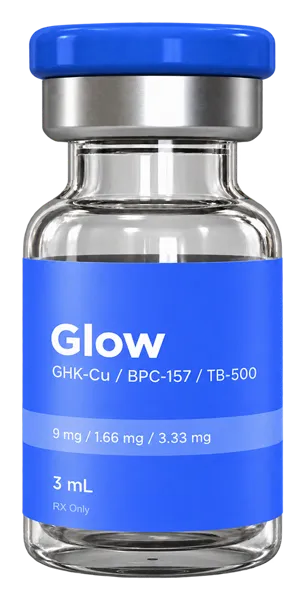
| Glow blend (GHK-Cu, BPC-157, TB-500) | Everything listed for the injection, plus the unknowns of two more peptides, a combination nobody has tested, and documented vial mislabeling | Press reports, a BPC-157 systematic review, our glow-blend research review | Untested as a combination; its parts mostly animal data when injected |
The pattern is simple to state: the more often a form has been used and studied, the less dramatic its side-effect list, and the injectable forms are where the gaps are.
Is topical GHK-Cu safe for most people?
For most people using it as directed, yes: topical GHK-Cu is generally considered a gentle, well-tolerated skincare ingredient. GHK-Cu is a small copper-binding peptide that occurs naturally in human skin and blood, and it has a long cosmetic track record. The most comprehensive review of the ingredient notes that “it has been widely used in anti-aging and cosmetic products in humans for decades without any adverse effects, and can be easily incorporated in creams, liposomes, dermal patches” (Pickart & Margolina, Int. J. Mol. Sci., 2018). An earlier review by the same research group states that “no issues have ever arisen during its use as a skin cosmetic or in human wound healing studies” (Pickart, Vasquez-Soltero & Margolina, 2015). A 2026 narrative review of therapeutic peptides reached a similar verdict, describing topical GHK-Cu as very safe, with very few cases of irritation (Renke & Chinellato, 2026).
Two honest caveats keep that from being a blank check. First, the authors of the 2015 and 2018 reviews list their affiliation as the research and development department of Skin Biology, a commercial company, and the “without any adverse effects” verdict rests largely on decades of cosmetic use rather than on large, formal irritation-and-toxicity trials, so it is a reassuring history, not an airtight safety dossier. Second, “well tolerated on average” is a population statement; any individual can still react to any ingredient. Part of copper peptides’ appeal is their low-drama profile: unlike retinoids or strong exfoliating acids, they are not associated with the peeling, stinging, and sun-sensitivity adjustment period those stronger actives are known for. That gentleness is a real-world tolerability observation rather than the result of a published head-to-head irritation trial, so treat it as a reasonable expectation, not a guarantee.
What are the side effects of topical copper peptides?
The reported downsides of topical copper peptides are typically minor and local rather than systemic. In practice that means the kinds of reactions any active can cause: temporary redness, mild stinging or itching, or a localized irritant reaction, usually where the product was applied and usually settling once you stop. Copper-peptide serums are not known for the peeling, flaking, and sun sensitivity that define the retinoid adjustment period, which is a large part of why they are marketed as gentle.
You should be cautious about very specific side-effect statistics floating around online. A number of ingredient-selling blogs cite precise-sounding figures (“4.2% had redness,” “pooled data from 892 participants”) that are not traceable to a published, peer-reviewed safety study, and we do not repeat them here. The trustworthy version is less tidy but accurate: topical GHK-Cu has a low reported irritation profile, the problems that do occur are mostly mild and local, and the single most reliable way to find out how your own skin responds is to introduce it carefully. For what the creams actually do for skin, and how strong that evidence is, see our guide to GHK-Cu copper peptides for skin.
Who should be cautious with GHK-Cu?
People who are pregnant or breastfeeding, have reactive or damaged skin, have a known copper or nickel allergy, or use prescription topicals should be more careful, and anyone considering the injection has a separate set of questions. Gentle-on-average is not the same as right-for-everyone. As with any new skincare active, a short list of precautions covers most of the risk:
- Patch-test first. Apply a small amount to a discreet area (inner forearm or behind the ear) for a few days before putting it on your whole face, so an individual reaction shows up somewhere low-stakes.
- Introduce it alone. Add copper peptides on their own rather than alongside several other new products, so that if something flares you actually know which ingredient caused it.
- Pregnant or breastfeeding. Data specific to this situation are limited; check with your clinician before adding any new active rather than assuming it is fine.
- Sensitive or compromised skin. If you have eczema, rosacea, or an active flare, a damaged barrier reacts more readily to anything, copper peptides included.
- Already using prescription topicals. If you are on a prescription retinoid or another medicated cream, ask the prescriber before layering, both to avoid irritation and to keep your routine coherent.
None of these are alarms; they are the ordinary “go slow and check” steps that apply to most actives. If a skin concern is medical, such as persistent acne, a suspicious spot, or a rash that will not settle, that is a reason to see a provider for a diagnosis, not a reason to reach for a serum. Our guide to building a peptide skin routine safely covers how to fold a new peptide in without overloading your skin.
Can copper peptides cause a copper allergy?
Copper contact allergy is real but uncommon, and usually of low clinical relevance. A review of the copper-allergy literature found that among people with suspected exposure or related symptoms who were patch-tested, a weighted average of 3.8% had a positive reaction to copper. The authors concluded that copper is a very weak sensitizer compared with other metals and that allergic reactions to it are only infrequently reported despite widespread human exposure, although in a few selected cases it can cause clinically relevant reactions (Fage et al., Contact Dermatitis, 2014). In other words, a positive patch test to copper does not automatically translate into a real-world skin problem for most people.
The practical takeaway is proportionate. The same review notes that copper shares many qualities with nickel, a known strong sensitizer, so if you have a known copper allergy or a history of metal allergy, be more careful and consider talking to a dermatologist before using a copper-peptide product. For everyone else, the small background rate of copper sensitivity is one more reason the patch-test-first rule is worth following, not a reason to avoid the ingredient outright.
What are the side effects of injectable GHK-Cu?
The side effects of injectable GHK-Cu have never been measured in a published human trial, so what is known comes from animal research, a small number of clinician reports and an FDA safety summary. The human skin results in the main reviews come from creams and other products applied to the skin, while the studies of GHK-Cu given systemically or by injection were done in animals such as mice, rats and pigs (Pickart & Margolina, 2018). A PubMed search we ran on October 12, 2026, filtered to clinical and randomized trials of injected GHK-Cu in people, returned no results. NPR’s September 2026 report on the trend put it plainly: there is no data from published human studies to show the practice is safe and effective (NPR, 2026). For why the trend moved from serums to syringes and how the two routes compare beyond side effects, see our explainer on GHK-Cu peptide injections.
What has been reported so far:
- Injection-site problems and liver findings. A doctor of nursing practice who runs a wellness clinic near Seattle told NPR that most of his GHK-Cu consults are with people who bought it online and injected it themselves. The problems he sees range from injection-site irritation and infections to elevated liver enzymes and raised copper levels in people who had been injecting too much without checking lab work. NPR notes it is unclear whether the copper peptide or undisclosed substances or impurities were responsible (NPR, 2026).
- A possible immune reaction. FDA’s written safety summary for injectable GHK-Cu says compounded injectable versions may pose a risk of immunogenicity (an immune response against the product) because of the potential for aggregation and peptide-related impurities, and that there are limited human data to inform safety (FDA).
- Too much copper. A University of Washington researcher who has studied GHK for years told NPR it is generally quite safe based on animal studies, and said he would not inject it himself without really knowing what it will do. In the same passage NPR listed overloading the body with copper or triggering a dangerous immune reaction among the potential risks of injection (NPR, 2026).
- Not knowing what is in the vial. A dermatologist quoted by NPR said that whether a grey-market product is even a copper peptide “is always a concern,” and that the stakes are higher when you inject. Dermatologists told NPR they advise patients to hold off on injecting (NPR, 2026).
The wider literature points the same way. A 2026 review in Sports Medicine that covered GHK-Cu among other unapproved peptides concluded that many show favorable effects in animal models but that rigorous human safety data are scarce and there is potential for serious harm (Mendias & Awan, 2026). Worth adding for balance: the same clinician who described the liver findings told NPR that in his experience the topicals work much better for skin and hair, and injecting copper peptides tends to have minimal impact. So the decades of uneventful cosmetic use tell you about serums, not about injections. For the broader picture of the molecule, including what the injection is supposed to do, see the GHK-Cu overview on The Treatment Report.
What are the side effects of GHK-Cu in the Glow blend?
The Glow blend has no measured side-effect profile at all, because no published study has tested GHK-Cu, BPC-157 and TB-500 together in people or animals; a PubMed search we ran on October 12, 2026, for papers naming all three turned up only review articles, not a study of the combination. Everything above about injected GHK-Cu applies, and the two added peptides bring their own gaps. A 2025 systematic review of BPC-157 found 35 preclinical studies and one clinical study, no clinical safety data in humans, and warned that adverse effects are possible from unregulated manufacturing, contamination or unknown clinical safety (Vasireddi et al., 2025). For TB-500, a PubMed search we ran on October 12, 2026, for clinical or randomized trials returned no relevant results.
The blend also adds a supply problem. TIME reported in February 2026 that BTLabs, a drug-testing company, found at least 20% of the unapproved peptides it had tested since the previous October were mislabeled, and its co-founder gave the example of a vial labeled Glow that was actually a different blend called Klow, or the other way round (TIME, 2026). If you are not sure what is in a vial, you cannot be sure which side effects to expect. Our glow peptide explainer walks through each ingredient’s evidence, how the blend compares with a copper-peptide serum and with the “Wolverine” recovery stack, and the cost context.
| Question | Topical GHK-Cu | Injectable GHK-Cu | Glow blend |
|---|---|---|---|
| Studied in people? | Yes, small cosmetic studies | No published human trials | No study of the combination at all |
| Most common reported problem | Mild, local irritation | Injection-site irritation and infection (clinician report) | Same as injection, plus unknowns from two more peptides |
| Biggest open question | Individual sensitivity, copper allergy | Copper load, immune reaction, product quality | Interactions, product quality, mislabeling |
Do copper peptides really wreck your sleep?
There is no controlled evidence that they do. You will find online stories claiming copper peptides ruined someone’s sleep, made them wired, or caused restlessness. They are anecdotes shared in peptide forums, and there is no controlled clinical evidence showing that topical copper-peptide skincare disrupts sleep. Be skeptical of blogs that cite an “FDA drug label for GHK-Cu” listing sleep-related effects: no such FDA drug label exists, so that citation is not real.
Mechanistically, a topical peptide applied to the skin surface is a very different exposure from a substance injected into the body, and the established evidence base for GHK-Cu on skin is about local, cosmetic effects rather than whole-body ones (Pickart, Vasquez-Soltero & Margolina, 2015). That does not prove no one has ever felt off after using a serum, since individual reactions happen, but it does mean the “copper peptides wreck your sleep” narrative is an anecdote without controlled evidence behind it, not an established risk of a copper-peptide moisturizer. If any product genuinely seems to affect how you feel, the sensible move is the same: stop, and talk to a clinician.
What are people saying about GHK-Cu side effects?
Online, GHK-Cu side effects come up less as a topic of their own and more as asides inside bigger peptide conversations. NPR described copper peptides as “the darling of social media skin care hacks,” with people either applying the blue liquid to their faces or drawing it into syringes, and noted the ingredient has become a staple of looksmaxxing content (NPR, 2026). Our community tracker does not yet have a dedicated GHK-Cu dataset, but the copper peptide turns up in the X posts we collected in July 2026 for other peptides:
- A histamine-type reaction, and a workaround. In 13 thymosin alpha-1 posts collected July 9 to 16, 2026, one user said mixing thymosin alpha-1 with GHK-Cu eliminated her histamine response to GHK-Cu, while another named thymosin alpha-1 among peptides they consider incompatible for mixing with certain others. Neither claim has been tested; the first is notable mainly because it describes a reaction to GHK-Cu at all.
- GHK-Cu as a line item in bigger stacks. In 19 MOTS-c posts collected July 16 to 19, 2026, users described running MOTS-c alongside items such as NAD+, GHK-Cu and GLP peptides. In 8 KPV posts from July 18 to 20, 2026, users described stacking KPV with peptides such as BPC-157, TB-500 and GHK.
Our read: the community conversation is mostly about what to combine GHK-Cu with, not about measured side effects, and stacking several injectables at once makes it harder for anyone to tell which one caused a reaction. These are a small number of unverifiable self-reports collected over a few days. They show what people are trying and arguing about, not how safe GHK-Cu is.
Status (injectable GHK-Cu): Not FDA-approved; sold by some telehealth providers as a compounded prescription. What these status terms mean.
The bottom line on GHK-Cu side effects
For topical, cosmetic use, GHK-Cu is a reasonably gentle, well-tolerated ingredient with a long history and no consistently reported adverse effects, and the real cautions are modest: patch-test first, introduce it alone, and be more careful if you are pregnant, breastfeeding, sensitive-skinned, metal-allergic, or on prescription topicals (Pickart & Margolina, 2018; Fage et al., 2014). The injection is a separate question: there are no published human trials, and what is reported (injection-site problems, liver and copper findings in self-injectors, a possible immune reaction) comes from clinicians and FDA’s safety summary rather than measured rates (NPR, 2026). The Glow blend stacks two more untested peptides and a mislabeling problem on top of that. The sleep stories are anecdotal, with no controlled evidence behind them.
Sources and further reading
Every clinical and safety statement on this page traces to a primary source, listed here so you can verify it directly.
- Pickart L, Margolina A. Regenerative and Protective Actions of the GHK-Cu Peptide in the Light of the New Gene Data. Int. J. Mol. Sci. 2018;19(7):1987
- Pickart L, Vasquez-Soltero JM, Margolina A. GHK Peptide as a Natural Modulator of Multiple Cellular Pathways in Skin Regeneration. BioMed Research International, 2015;2015:648108
- Fage SW, Faurschou A, Thyssen JP. Copper hypersensitivity. Contact Dermatitis, 2014;71(4):191-201
- Renke G, Chinellato L. Therapeutic Peptides in Aesthetic, Metabolic and Endocrine Conditions: Effects, Safety, Clinical Applications, and Future Perspectives. Int J Mol Sci. 2026;27(9):3890
- Mendias CL, Awan TM. Safety and Efficacy of Approved and Unapproved Peptide Therapies for Musculoskeletal Injuries and Athletic Performance. Sports Med. 2026;56(8):1921-1935
- Vasireddi N, et al. Emerging Use of BPC-157 in Orthopaedic Sports Medicine: A Systematic Review. HSS J. 2025;21(4):485-495
- U.S. Food & Drug Administration. Certain Bulk Drug Substances for Use in Compounding that May Present Significant Safety Risks (GHK-Cu, injectable routes)
- Stone W. The copper peptide trend has gone from creams to injections, ahead of the science. NPR, September 7, 2026
- Mosbergen D. What to Know About the “Anti-Aging” Peptide Shots Flooding Social Media. TIME, February 24, 2026
Educational information only, not medical advice. Community observations come from our July 2026 X post collections for thymosin alpha-1, MOTS-c and KPV. Every scientific statement here is sourced to the primary literature, FDA records and reporting cited above; updated October 12, 2026.
Advertising disclosure: links marked "Paid link" go to Bodybuilding Peptides (trybbpeptides.com), an affiliate destination, and Complexion Science may earn a commission if you buy there. Our coverage is independent of that relationship, and nothing on this page is medical or legal advice.
 See it at Bodybuilding Peptides