KLOW vs Glow peptide: the four-peptide blend, the three-peptide blend, and the evidence for each part
The short answer
Glow is an injectable blend of three peptides: GHK-Cu, BPC-157 and TB-500. KLOW is the same three plus a fourth, KPV, an anti-inflammatory fragment of the hormone alpha-MSH. KPV has only cell and animal studies, mostly mouse colitis. Neither blend has been studied as a combination, in people or animals.
KLOW vs Glow is the peptide-blend argument of the moment. Both names circulate on TikTok, Instagram and X as injectable “skin and repair” blends, and the debate usually comes down to one question: is the version with four peptides better than the version with three? This page is an explainer and a bit of social commentary. It sets out exactly what is in each blend, what the extra ingredient in KLOW is, the strength of the evidence for every component (stated in words), what has never been tested, the side effects that have been reported, and what people online are saying. It is educational only, not medical advice, and it does not tell anyone how to use either product.
What is the difference between KLOW and Glow peptide?
The difference between KLOW and Glow is one ingredient: KLOW contains everything in Glow plus KPV. Glow is a blend of three peptides, GHK-Cu, BPC-157 and TB-500. The New Yorker, reporting in April 2026 on people injecting peptides bought online, described the KLOW blend as a stack of “supposedly healing peptides” that includes KPV, GHK-Cu, TB-500 and BPC-157 (The New Yorker, 2026). So the real KLOW vs Glow question is narrower than social media makes it sound: what, if anything, does KPV add?
| Glow | KLOW | |
|---|---|---|
| GHK-Cu (copper peptide) | Yes | Yes |
| BPC-157 | Yes | Yes |
| TB-500 | Yes | Yes |
| KPV | No | Yes |
| Pitched mainly as | Skin, “glow” and repair | Repair plus inflammation |
| Studied as a blend | No | No |
| Weakest-evidence part | TB-500 (no human trials of the fragment) | KPV and TB-500 (no human trials of either) |
Both names are retail labels, not defined drugs, so there is no official recipe behind either word and the amounts of each peptide are set by whoever sells the vial. That matters for the rest of this comparison: everything below is about the ingredients, because nobody has tested the products.
What is in KLOW peptide?
KLOW peptide contains four peptides: GHK-Cu, BPC-157, TB-500 and KPV (The New Yorker, 2026). The first three are the Glow trio. The fourth, KPV, is a three-amino-acid fragment (lysine, proline, valine) of alpha-melanocyte-stimulating hormone, or alpha-MSH. A 2008 review in Endocrine Reviews explains why researchers singled it out: alpha-MSH calms inflammation but also darkens skin, and KPV was described as keeping the anti-inflammatory effect “but lack of pigmentary action” (Brzoska et al., 2008).
That lineage is a nice piece of trivia for a skin site. Alpha-MSH is the same hormone family that the tanning peptide Melanotan II mimics (its skin risks are covered in is Melanotan safe for tanning?), yet KPV is the slice of it studied precisely because it does not tan. In KLOW, it is there for inflammation, not color.
What’s in glow peptide?
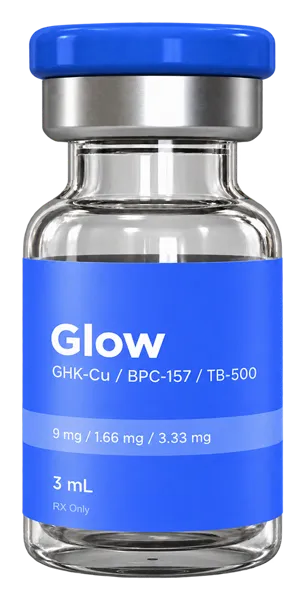
Glow peptide contains three peptides: GHK-Cu, BPC-157 and TB-500. One retailer, Bodybuilding Peptides, lists its Glow Blend as an injectable combining exactly those three in a single 3 mL vial (product listing, checked October 12, 2026). That retailer sells Glow but does not list a KLOW blend in its catalog as of the same date, so comparing the two there is not possible.
What is glow peptide?
Glow peptide is a product name for an injectable blend of GHK-Cu, BPC-157 and TB-500, promoted on social media for firmer, clearer and better-healing skin. It is not a single new molecule, and the blend itself has never been studied. Our full guide to what the glow peptide is covers why it took off, the evidence for each part, and what before-and-after posts can and cannot show.
Why is KLOW vs Glow trending?
KLOW vs Glow is trending because blends, not single peptides, have become the default way peptides are sold and talked about online. TIME reported in February 2026 that people on social media experiment with stacks that carry names like “Wolverine” and with blends, meaning multiple peptides mixed in the same vial (TIME, 2026). NPR’s September 2026 report on injected copper peptide noted that GHK-Cu is sometimes “stacked” with other peptides promoted for tissue repair and anti-aging (NPR, 2026).
Glow and KLOW are the two blends that put a skincare ingredient, GHK-Cu, at the center of that trend, and their names differ by a single letter. That makes them easy to compare in a 30-second video and easy to confuse in real life, which turns out to be a real problem (see below).
What does the evidence show for each component?
The evidence for every component of KLOW and Glow is thin when injected, and it ranges from small human skin-cream studies for GHK-Cu down to cell and mouse studies for KPV. The table puts the four side by side; the sections after it explain each row.
| Component | In Glow? | In KLOW? | What it is | Where most of the evidence comes from | Evidence level, in words |
|---|---|---|---|---|---|
| GHK-Cu | Yes | Yes | A copper-binding tripeptide found in human plasma, levels falling with age | Cell and animal work, plus small human studies of creams and serums | Small human cosmetic studies, topical only; none of injection |
| BPC-157 | Yes | Yes | A synthetic 15-amino-acid peptide first isolated from gastric juice | Rat and other animal studies; three tiny human pilot studies | Mostly animal studies; human data limited to pilot reports |
| TB-500 | Yes | Yes | A synthetic fragment of thymosin beta-4 | The human trials we found are of the full-length parent protein, used topically | No human trials of the fragment itself |
| KPV | No | Yes | A three-amino-acid fragment of alpha-MSH | Human cell lines and mouse colitis models; a few skin-cell studies | Cell and animal studies only; no human trials |
| The blend | Untested | Untested | All parts in one injectable | Nothing published | Untested as a combination |
GHK-Cu. GHK-Cu has the best human evidence of the four, but all of it is for products applied to the skin. A 2015 review from authors at Skin Biology, a copper-peptide skincare company, reports that in cosmetic products GHK has been found to tighten loose skin, improve elasticity and firmness, and reduce fine lines (Pickart et al., 2015). NPR describes the controlled human studies as generally small trials funded by the cosmetic industry (NPR, 2026). One small independent randomized study, in 13 patients after laser resurfacing, found no objective difference in wrinkles or skin quality with GHK-Cu products, although users reported higher satisfaction (Miller et al., 2006). NPR also reports there is no data from published human studies showing that injecting it is safe and effective. The hub’s GHK-Cu overview collects the wider research.
BPC-157. BPC-157’s evidence is almost entirely preclinical. A 2025 systematic review found 36 eligible studies, 35 of them preclinical and one clinical, and found no clinical safety data (Vasireddi et al., 2025). A separate 2025 review counted only three human pilot studies and concluded that BPC-157 “should be considered investigational” until well-designed trials are done (McGuire et al., 2025).
TB-500. TB-500 has no published human trials of its own. Anti-doping chemists identified a short acetylated fragment of thymosin beta-4 (amino acids 17 to 23) in a product sold as TB-500 (Esposito et al., 2012). The human trials we found used the full-length protein, applied topically: a Phase 2 trial in 73 people with venous leg ulcers (Guarnera et al., 2010) and a Phase 2 dry-eye trial of eye drops in 72 people that missed both primary endpoints (Sosne and Ousler, 2015). That is a different molecule given a different way. The Wolverine stack guide on The Recovery Dose covers BPC-157 and TB-500 as a pair, which is the core that Glow and KLOW share.
KPV. KPV’s evidence comes from cells and rodents, mostly models of inflammatory bowel disease. The most-cited study, in Gastroenterology, found that nanomolar concentrations of KPV inhibited inflammatory signaling in human intestinal and immune cell lines, and that KPV added to drinking water reduced chemically induced colitis in mice; the authors concluded it “might be a new therapeutic agent for IBD” (Dalmasso et al., 2008). A second group reported earlier recovery and less inflammation in two mouse colitis models (Kannengiesser et al., 2008), and a 2023 review notes that the experience with the wider melanocortin system in bowel inflammation comes largely from mouse models of colitis (Gravina et al., 2023). Our sister site’s KPV research guide goes through those studies one by one.
What does KPV add for skin?
For skin specifically, KPV adds a laboratory rationale, not a demonstrated benefit. In human skin cells (HaCaT keratinocytes) exposed to fine dust pollution, KPV reduced inflammation and cell death, and it also reduced inflammatory cell death in a three-dimensional lab skin model (Sung et al., 2025). Earlier work showed KPV triggering signaling in human keratinocytes in the lab (Elliott et al., 2004). A 2025 review of tripeptides in wound healing, which covers both GHK and KPV, describes KPV-loaded hydrogels reducing inflammation and supporting tissue regeneration in experimental work, and says future research still needs to improve stability, bioavailability and delivery (Adnan et al., 2025).
None of those studies injected KPV into a person, and none looked at complexion, wrinkles or “glow.” The honest reading is that KLOW adds an ingredient with a plausible anti-inflammatory mechanism in dishes and rodents, on top of three ingredients that are themselves mostly unproven by injection.
Has KLOW or Glow been studied as a blend?
No. We found no published study of either blend, in people or in animals. A PubMed search on October 12, 2026, for KPV together with GHK, BPC-157 or TB-500 returned two papers, a pharmacy-compounding commentary and a review of tripeptides in wound healing; neither tested the peptides together. ClinicalTrials.gov lists no registered study with KPV as an intervention (ClinicalTrials.gov search), and a PubMed search for clinical or randomized trials of KPV under its chemical name (Lys-Pro-Val) also returned none. PeptideAgent’s KLOW profile likewise finds no study of the combination and notes that KPV itself has no human trial.
A blend raises questions that the individual studies cannot answer: how the parts interact, whether they stay stable in the same vial, and what the total exposure is. TIME quoted longevity expert Eric Topol making exactly this point, that it is not clear how peptides taken together interact with one another (TIME, 2026). Adding a fourth untested ingredient to an untested three-way blend does not make the question smaller.
What are the side effects of KLOW and Glow?
The side effects of KLOW and Glow have never been measured in a trial, so what is known comes from clinician reports and from the risks of unregulated injectables in general. A clinician interviewed by NPR described problems in people injecting grey-market GHK-Cu ranging from injection-site irritation and infections to elevated liver enzymes and raised copper levels; NPR notes it is unclear whether the copper peptide or undisclosed substances or impurities were responsible (NPR, 2026). The 2025 BPC-157 systematic review warns that adverse effects are possible from unregulated manufacturing, contamination or unknown clinical safety (Vasireddi et al., 2025).
For KPV, there is simply no human side-effect data to report, because there are no human trials. Its parent hormone’s skin-darkening effect is not expected, since KPV is described as lacking it (Brzoska et al., 2008), but “not expected” is a prediction from lab work, not a safety record. Nobody has studied either blend in pregnancy, breastfeeding, or liver or kidney disease, and anyone in tested sport should know that BPC-157 is banned in professional sports (Vasireddi et al., 2025). Those are situations where a clinician conversation should come first.
Can you tell KLOW and Glow apart by the label?
Not reliably. TIME reported that at least 20% of the unapproved peptides tested by the drug-testing company BTLabs since the previous October were mislabeled, and its co-founder said a vial might say Glow when it is actually Klow, or the other way round (TIME, 2026). The New Yorker’s reporter sent peptides bought online to a peptide-testing company for purity and potency testing and reported that all the peptides ordered from one of those sellers had significant issues (The New Yorker, 2026).
In other words, the KLOW vs Glow debate online assumes that the name on the vial matches the contents. The best evidence on that assumption says it often does not.
Is KLOW or Glow better for skin?
Neither has been shown to be better for skin, because neither has been tested for skin at all. If you are choosing purely on evidence, the strongest skin data in either blend belongs to GHK-Cu, and that data comes from creams and serums rather than injections. KLOW’s extra ingredient, KPV, has anti-inflammatory results in cells and rodents and a handful of skin-cell experiments, which is a reason for researchers to study it, not evidence that a four-peptide vial beats a three-peptide one.
| If your question is… | What the evidence supports |
|---|---|
| Firmer skin, fewer fine lines | Small, mostly industry-funded studies of topical GHK-Cu; nothing for either injectable blend |
| Calmer, less inflamed skin | KPV reduced inflammation in human skin cells in the lab; no human study |
| Healing after injury | Mostly animal studies of BPC-157; one small topical leg-ulcer trial of full-length thymosin beta-4, a different molecule |
| ”More is better” (four vs three) | No study of either combination, so no basis for ranking them |
If skin is the actual goal, our GHK-Cu copper peptides for skin guide covers the topical route, which is where the human data sit.
How does cost compare between KLOW and Glow?
Cost comparisons between KLOW and Glow often end up as comparisons between sellers. Bodybuilding Peptides, for example, sells Glow Blend and does not list KLOW (catalog checked October 12, 2026); our glow peptide guide carries a dated price snapshot for Glow.
In the X posts our community tracker collected, the cost discussion around KLOW was less about price than about format: commenters mentioned people paying monthly for the convenience of a single vial and argued about whether a blend is worth it compared with buying the compounds separately. Whatever the sticker price, a vial whose contents you cannot verify is hard to call good value.
What are people saying about KLOW vs Glow?
Online, KLOW shows up as a recovery-and-inflammation stack and Glow as the skin-leaning version, with a running argument about whether blends make sense at all. These are themes from small sets of public X posts collected by our community tracker, not evidence that either blend works.
- KLOW is framed as a recovery blend. In 12 KPV posts on X collected July 15 to 16, 2026, several described KLOW as a blend of KPV with BPC-157, TB-500 and GHK-Cu marketed toward recovery, and debated whether the single-vial format is worth it versus separate compounds.
- KPV rarely travels alone. In 8 KPV posts collected July 18 to 20, 2026, users described KPV as one piece of multi-peptide routines with BPC-157, TB-500 and GHK, with personal amounts and schedules that were not standardized.
- Skepticism about blends is common. In 16 TB-500 posts collected July 14 to 19, 2026, one commenter said they had stopped buying blended vials and preferred BPC-157 alone, and another said they were not convinced by the BPC-157 and TB-500 combination.
- Access is not proof. Ahead of the July 2026 FDA advisory committee meeting, KPV commenters stressed that a review of whether pharmacies can make a peptide is a separate question from whether it works.
The social conversation tends to treat KLOW as “Glow plus,” an upgrade. The research record does not support ranking them, and the mislabeling findings suggest the more useful question is whether a vial contains what it says.
The bottom line on KLOW vs Glow
KLOW is Glow plus KPV. Glow’s three peptides are GHK-Cu, with small human studies only as a skin cream, and BPC-157 and TB-500, with mostly animal evidence. KPV adds an anti-inflammatory fragment of alpha-MSH studied in cells and rodents, mainly for gut inflammation, with a few skin-cell experiments and no human trials. Neither blend has been studied as a combination, side effects have not been measured, and testing labs have found vials labeled Glow that were KLOW and the reverse. If your goal is skin, the human evidence points to topical copper peptides first, and to a clinician before anything you would inject.
Status: Not FDA-approved; sold by some telehealth providers as a compounded prescription. An FDA advisory committee reportedly voted in July 2026 to recommend allowing pharmacies to compound it; nothing has changed yet. This applies to BPC-157, TB-500 and KPV; injectable GHK-Cu is also not FDA-approved. What these status terms mean.
Sources and further reading
- Khullar D. Why Are People Injecting Themselves with Peptides? The New Yorker, April 13, 2026 issue
- Mosbergen D. What to Know About the “Anti-Aging” Peptide Shots Flooding Social Media. TIME, February 24, 2026
- Stone W. The copper peptide trend has gone from creams to injections, ahead of the science. NPR, September 7, 2026
- Pickart L, Vasquez-Soltero JM, Margolina A. GHK Peptide as a Natural Modulator of Multiple Cellular Pathways in Skin Regeneration. Biomed Res Int. 2015;2015:648108
- Miller TR, et al. Effects of topical copper tripeptide complex on CO2 laser-resurfaced skin. Arch Facial Plast Surg. 2006;8(4):252-9
- Vasireddi N, et al. Emerging Use of BPC-157 in Orthopaedic Sports Medicine: A Systematic Review. HSS J. 2025;21(4):485-495
- McGuire FP, et al. Regeneration or Risk? A Narrative Review of BPC-157 for Musculoskeletal Healing. Curr Rev Musculoskelet Med. 2025;18(12):611-619
- Esposito S, et al. Synthesis and characterization of the N-terminal acetylated 17-23 fragment of thymosin beta 4 identified in TB-500. Drug Test Anal. 2012;4(9):733-8
- Guarnera G, DeRosa A, Camerini R. The effect of thymosin treatment of venous ulcers. Ann N Y Acad Sci. 2010;1194:207-12
- Sosne G, Ousler GW. Thymosin beta 4 ophthalmic solution for dry eye: a randomized, placebo-controlled, Phase II clinical trial. Clin Ophthalmol. 2015;9:877-84
- Brzoska T, et al. Alpha-melanocyte-stimulating hormone and related tripeptides. Endocr Rev. 2008;29(5):581-602
- Dalmasso G, et al. PepT1-mediated tripeptide KPV uptake reduces intestinal inflammation. Gastroenterology. 2008;134(1):166-78
- Kannengiesser K, et al. Melanocortin-derived tripeptide KPV has anti-inflammatory potential in murine models of inflammatory bowel disease. Inflamm Bowel Dis. 2008;14(3):324-31
- Gravina AG, et al. The Melanocortin System in Inflammatory Bowel Diseases: Insights into Its Mechanisms and Therapeutic Potentials. Cells. 2023;12(14):1889
- Elliott RJ, et al. Alpha-melanocyte-stimulating hormone, MSH 11-13 KPV and adrenocorticotropic hormone signalling in human keratinocyte cells. J Invest Dermatol. 2004;122(4):1010-9
- Sung J, et al. Lysine-Proline-Valine peptide mitigates fine dust-induced keratinocyte apoptosis and inflammation. Tissue Cell. 2025;95:102837
- Adnan SB, et al. Exploring the Role of Tripeptides in Wound Healing and Skin Regeneration: A Comprehensive Review. Int J Med Sci. 2025;22(16):4175-4200
- ClinicalTrials.gov search for KPV as an intervention, checked October 12, 2026
Educational information only, not medical advice. Community observations come from our July 2026 X post collections for KPV and TB-500. Updated October 12, 2026.
Advertising disclosure: links marked "Paid link" go to Bodybuilding Peptides (trybbpeptides.com), an affiliate destination, and Complexion Science may earn a commission if you buy there. Our coverage is independent of that relationship, and nothing on this page is medical or legal advice.
 See it at Bodybuilding Peptides