Oral minoxidil and finasteride: why hair-loss communities pair them, and what the combination studies actually show

The short answer
People pair oral minoxidil with finasteride because the two drugs act on different parts of pattern hair loss: finasteride lowers DHT, the hormone that shrinks follicles, while minoxidil pushes follicles to grow. Randomized trials support finasteride plus topical minoxidil; the all-oral pairing so far rests on one retrospective, company-run study.
Oral minoxidil and finasteride are often paired for pattern hair loss. Sometimes they are two separate tablets, sometimes a telehealth service sells them as one combined pill. The logic behind it is simple: hit the problem from two directions at once. This page explains what each drug actually does, what the combination studies found (with the strength of that evidence stated in words), the side-effect questions that come up most, and how the all-oral version compares with the older finasteride-plus-topical approach. It is educational only, not medical advice, and it does not tell anyone what to take or how much.
Why do people take oral minoxidil and finasteride together?
People combine them because the two drugs work on different parts of pattern hair loss, so in theory their effects add up rather than overlap. Finasteride is a 5-alpha-reductase inhibitor: it blocks the enzyme that turns testosterone into dihydrotestosterone (DHT), and the Propecia label reports a 65% drop in blood DHT within 24 hours of a 1 mg tablet (Propecia label, DailyMed). Minoxidil does something else entirely. A 2025 study describes it as a vasodilator, first developed for blood pressure, that is thought to increase blood flow to follicles, extend the growth (anagen) phase and promote thicker hair shafts, while finasteride slows the follicle shrinkage that DHT drives (Johnson et al., Cureus, 2025). The all-oral version adds a convenience argument: two tablets, or one combined tablet, instead of a tablet plus a twice-daily scalp application.
What does finasteride do that minoxidil does not?
Finasteride targets the hormonal driver of male pattern hair loss, which minoxidil does not touch. That is the core of the pairing, and it is why the two are described as complementary rather than interchangeable. The table below sets the two drugs side by side.
| Factor | Finasteride (1 mg tablet) | Oral minoxidil (low dose) |
|---|---|---|
| What it targets | Blocks type II 5-alpha-reductase, lowering DHT | Thought to act on follicle blood flow and the growth phase |
| Approval for hair loss | FDA-approved for male pattern hair loss, men only | Off-label; the tablet is approved for hard-to-control high blood pressure |
| Use in women | Not indicated; contraindicated in pregnancy | Used off-label in women in published studies |
| Evidence level, in words | Approved drug, labeled use, with placebo-controlled trials running up to five years | A small head-to-head randomized trial against topical minoxidil, plus large retrospective case series |
| Side effects people ask about | Sexual side effects; postmarketing reports of persistent symptoms and depression | Unwanted body hair, lightheadedness, fluid retention, fast heart rate |
| What happens if you stop | Hair count gains reversed within 12 months of switching to placebo in the trials | Label: unwanted body hair reverses after stopping, over 1 to 6 months |
Sources: Propecia label; minoxidil tablets label; Vañó-Galván et al., JAAD, 2021; Penha et al., JAMA Dermatology, 2024.
Finasteride’s own trial record is the strongest part of this whole story. In the label’s two vertex-baldness studies, men on finasteride had 107 more hairs than placebo in a one-inch circle at 12 months, and the gap widened to 277 hairs at five years because the placebo group kept losing hair. At five years, 100% of the placebo group showed hair loss against 35% of men on finasteride (Propecia label). Men who switched from finasteride to placebo after a year lost their gain by month 24, so the benefit lasts only as long as the drug is taken.
Does oral minoxidil work?
Yes, in studies so far oral minoxidil grows hair about as well as topical minoxidil, not clearly better. The best evidence is a 2024 double-blind trial of 90 men that found 5 mg oral minoxidil “did not demonstrate superiority” over 5% topical minoxidil at 24 weeks; the authors described the oral drug’s side effects as mild, with unwanted hair growth more common than on topical (Penha et al., 2024). Our full guide to oral minoxidil for hair loss covers the trials, the side-effect data and why the pill became popular.
What do the combination studies show?
The combination has real trial support, but almost all of it is for finasteride plus topical minoxidil; the all-oral version is much thinner. Here is what exists, from strongest to weakest for the question this page is about:
- Finasteride tablet plus topical minoxidil (randomized trial). A 2015 study randomly assigned 450 Chinese men with pattern hair loss to finasteride 1 mg, 5% topical minoxidil, or both for 12 months. Improvement was seen in 80.5% on finasteride, 59% on minoxidil and 94.1% on the combination, and adverse reactions were rare (Hu et al., Dermatol Ther, 2015). It was a single-country trial, and it tested topical, not oral, minoxidil.
- Finasteride and minoxidil mixed in one scalp solution (meta-analysis). A 2025 meta-analysis of seven randomized trials with 396 men found the topical mix beat minoxidil solution alone on hair density, hair diameter and photo assessment, with low to moderate certainty and small trials (Li et al., Front Med, 2025).
- Oral minoxidil plus oral finasteride in one tablet (retrospective, no control group). A 2025 service evaluation looked back at 502 men who took a combined tablet (finasteride 1 mg with minoxidil 2.5 mg) through a UK digital health service for 12 months. On a clinician-rated photo scale, 92.4% were stable or improved and 57.4% improved (Johnson et al., 2025).
That last study is the one most often quoted for the all-oral stack, so its limits matter. It had no control or placebo group and no randomization, it only included men who stayed on treatment for about a year and sent usable photos, the two raters agreed only slightly on the change scores (kappa 0.20), and side effects were not systematically collected. All five authors were employed by the company that ran the service. The authors themselves say prospective randomized trials are needed. The evidence level for oral minoxidil plus finasteride, in words: two approved drugs, one used off-label, combined on the strength of each drug’s own trials, with only retrospective real-world data for the pairing itself.
The 2024 oral minoxidil trial authors also listed combinations with 5-alpha-reductase inhibitors such as finasteride among the questions that still need larger trials (Penha et al., 2024).
Is oral minoxidil plus finasteride better than finasteride plus topical minoxidil?
Nobody has tested that head to head, so the honest answer is unknown. What can be pieced together: oral and topical minoxidil grew similar amounts of hair in a randomized trial (Penha et al., 2024), and finasteride plus topical minoxidil beat either drug alone in a randomized trial (Hu et al., 2015). It is reasonable to expect the oral pairing to land somewhere similar, but that is an inference, not a result.
A 2022 network meta-analysis of 23 trials in JAMA Dermatology ranked single drugs, not combinations. Its order, from most to least likely to be most effective, was dutasteride 0.5 mg, finasteride 5 mg, oral minoxidil 5 mg, finasteride 1 mg, 5% topical minoxidil, 2% topical minoxidil and oral minoxidil 0.25 mg (Gupta et al., JAMA Dermatology, 2022). It is tempting to read that ranking as proof that oral minoxidil beats finasteride 1 mg, but the authors called it “one possible ranking” that future randomized trials would need to confirm, and a network meta-analysis mostly compares drugs indirectly across separate trials.
| Approach | Best evidence for the pairing | Main trade-off |
|---|---|---|
| Finasteride tablet + topical minoxidil | Randomized trial of 450 men, 12 months | Twice-daily scalp routine; scalp irritation |
| Topical finasteride + minoxidil solution | Meta-analysis of seven small randomized trials | Still a scalp routine; less trial data than the tablet |
| Finasteride tablet + oral minoxidil | One retrospective company study of 502 men, no control | Two systemic drugs; more unwanted body hair than topical minoxidil |
Sources: Hu et al., 2015; Li et al., 2025; Johnson et al., 2025; Penha et al., 2024.
What are the side effects of taking oral minoxidil and finasteride together?
Each drug brings its own side effects, and the combination has not been studied for side effects as a pair. The questions people raise fall into two groups.
Finasteride. In the label’s 12-month trials, drug-related decreased libido was reported by 1.8% on finasteride versus 1.3% on placebo, erectile dysfunction by 1.3% versus 0.7%, and ejaculation disorder by 1.2% versus 0.7%; 3.8% of men on finasteride reported at least one sexual side effect against 2.1% on placebo. These resolved in men who stopped and in most who kept taking it. After approval, the label adds voluntary reports of sexual dysfunction that continued after stopping, male infertility, depression, and suicidal ideation and behavior, noting that such reports cannot reliably establish frequency or cause (Propecia label). Finasteride also lowers PSA, the prostate cancer screening test, so anyone getting a PSA test should mention it.
Oral minoxidil. In a multicenter study of 1,404 people on low doses, the most common side effect was unwanted hair growth (15.1%), followed by lightheadedness (1.7%), fluid retention (1.3%) and fast heart rate (0.9%), with no life-threatening events (Vañó-Galván et al., 2021). The tablet label, written for its blood-pressure use, carries a boxed warning that minoxidil can cause pericardial effusion, fluid around the heart (minoxidil tablets label).
One practical problem: when two drugs start at once, it is hard to tell which one caused a new symptom. A 2025 consensus of 43 hair-loss specialist dermatologists from 12 countries agreed on items covering baseline evaluation and monitoring for people starting low-dose oral minoxidil (Akiska et al., JAMA Dermatology, 2025).
Can women take oral minoxidil and finasteride?
Finasteride is not approved for women, and the label says it should not be used in pregnancy because it can affect the genital development of a male fetus; pregnant women are told not to handle crushed or broken tablets. In a 12-month trial in 137 postmenopausal women, finasteride did no better than placebo (Propecia label). Oral minoxidil, by contrast, is widely used off-label in women; about two thirds of the 1,404-patient safety cohort were women (Vañó-Galván et al., 2021). So the stack, as discussed online, is mainly a men’s conversation.
How does the combination fit with peptides and other add-ons?
Copper peptides are a common add-on question, and they sit far lower on the evidence ladder. Our review of whether copper peptides help hair growth found mostly lab data, with the one human study of regrowth mixing copper peptides into a blend with minoxidil and dutasteride. A 2023 therapy review counts only two FDA-approved drugs for pattern hair loss, topical minoxidil and oral finasteride (Devjani et al., Drugs, 2023). The topical-versus-systemic trade-off that runs through this whole page is the same one we unpack in topical vs prescribed skin peptides: convenience and reach on one side, fewer whole-body effects on the other.
How much does the combination cost?
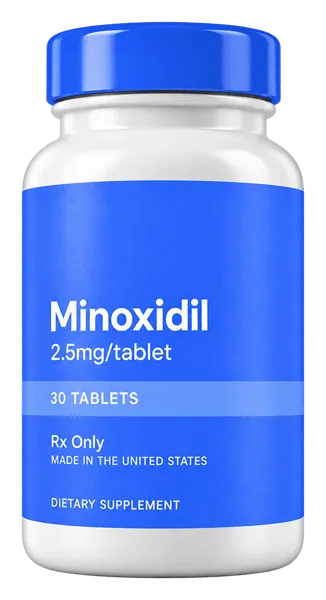
The cost depends on whether the two drugs come as separate prescriptions or a telehealth bundle, and on which pharmacy fills them. As a dated reference point, Bodybuilding Peptides listed a 2.5 mg oral minoxidil tablet at $99 for a one-month plan and $89 per month on a three-month plan when we checked on October 12, 2026, with $79 and $69 per month on six- and twelve-month plans. Finasteride is not sold there, so we do not list a price for it. Prices change, so treat this as a snapshot.
What are people saying about the oral minoxidil and finasteride stack?
Our community tracker has no dataset for this combination yet, so we do not quote or characterize forum posts here. This section sticks to what the published record shows about the claims that circulate:
- “One pill” is a product pitch. The largest dataset on the oral pairing comes from a telehealth company studying its own “All-in-One” tablet, and its authors were company employees (Johnson et al., 2025). That does not make the numbers wrong, but it is worth knowing when the 92.4% figure is passed around without context.
- The finasteride fear is real, and so is the uncertainty. Persistent sexual side effects and depression are listed on the label as postmarketing reports, a category that cannot establish how often they happen or whether the drug caused them (Propecia label). Both “it is totally harmless” and “it ruins everyone” go further than the evidence.
- Rankings get over-read. The 2022 network meta-analysis placed oral minoxidil 5 mg above finasteride 1 mg, but it compared single drugs, mostly indirectly, and did not test the combination (Gupta et al., 2022).
Myth versus evidence, in one line: “the combo works better than either drug alone” is supported for finasteride plus topical minoxidil; for the all-oral version it is a reasonable expectation that has not yet been tested in a randomized trial.
The bottom line on oral minoxidil and finasteride
Oral minoxidil and finasteride are paired because they do different jobs: finasteride lowers DHT, minoxidil pushes follicles to grow. Finasteride has the strongest trial record of the two, the finasteride-plus-topical-minoxidil combination has randomized support, and the all-oral pairing rests on each drug’s own data plus one retrospective study run by a company that sells it. Side effects come from each drug separately, with finasteride’s sexual and mood reports the most discussed and oral minoxidil’s extra body hair the most common. Whether the stack makes sense for any one person is a conversation for a dermatologist.
Status (oral minoxidil): Active ingredient is FDA-approved; compounded versions are not FDA-approved, and use for hair loss is off-label. What these status terms mean.
Sources and further reading
- PROPECIA (finasteride) tablets: prescribing information (DailyMed)
- Hu R, et al. Combined treatment with oral finasteride and topical minoxidil in male androgenetic alopecia: a randomized and comparative study in Chinese patients. Dermatol Ther. 2015;28(5):303-308
- Johnson H, Huang D, Clift AK, Bersch-Ferreira Â, Guimarães GA. Effectiveness of Combined Oral Minoxidil and Finasteride in Male Androgenetic Alopecia: A Retrospective Service Evaluation. Cureus. 2025;17(1):e77549
- Gupta AK, Venkataraman M, Talukder M, Bamimore MA. Relative Efficacy of Minoxidil and the 5-α Reductase Inhibitors in Androgenetic Alopecia Treatment of Male Patients: A Network Meta-analysis. JAMA Dermatol. 2022;158(3):266-274
- Li Y, Huang Q, Zhou Z, Zhang Y. Comparing minoxidil-finasteride mixed solution with minoxidil solution alone for male androgenetic alopecia: a systematic review and meta-analysis of randomized controlled trials. Front Med. 2025;12:1632139
- Penha MA, Miot HA, Kasprzak M, Müller Ramos P. Oral Minoxidil vs Topical Minoxidil for Male Androgenetic Alopecia: A Randomized Clinical Trial. JAMA Dermatol. 2024;160(6):600-605
- Vañó-Galván S, et al. Safety of low-dose oral minoxidil for hair loss: A multicenter study of 1404 patients. J Am Acad Dermatol. 2021;84(6):1644-1651
- Akiska YM, et al. Low-Dose Oral Minoxidil Initiation for Patients With Hair Loss: An International Modified Delphi Consensus Statement. JAMA Dermatol. 2025;161(1):87-95
- Minoxidil tablets, USP: prescribing information (DailyMed)
- Devjani S, et al. Androgenetic Alopecia: Therapy Update. Drugs. 2023;83(8):701-715
Educational information only, not medical advice. Our community tracker has no dataset for this combination yet; the community section summarizes the published record. Updated October 12, 2026.
Advertising disclosure: links marked "Paid link" go to Bodybuilding Peptides (trybbpeptides.com), an affiliate destination, and Complexion Science may earn a commission if you buy there. Our coverage is independent of that relationship, and nothing on this page is medical or legal advice.
 See it at Bodybuilding Peptides