Oral vs topical minoxidil: which is better, and why the debate continues

The short answer
Neither form clearly wins. In randomized trials, oral and topical minoxidil grew similar amounts of hair, with oral showing an edge only at the crown in one trial. Oral is simpler to take and avoids scalp irritation but causes more unwanted body hair; topical is FDA-approved over the counter, while oral use for hair is off-label.
Oral vs topical minoxidil became a much bigger question after an August 2022 New York Times article on the pill, when Google searches for oral minoxidil rose significantly and stayed up (Desir et al., Skin Appendage Disord, 2024). The short version of the evidence is less dramatic than the hype: when researchers have put the two head to head in randomized trials, they grew similar amounts of hair. The real differences are in the trade-offs. This page lines those up in one table (evidence, convenience, side effects, scalp irritation and cost), walks through what the trials actually measured, and explains why the debate keeps going. It reports what studies used and found; it is educational only and does not tell anyone what to take or how much.
Is oral minoxidil better than topical?
On the current evidence, oral minoxidil is not clearly better than topical minoxidil at growing hair; the two perform about the same in head-to-head trials. A 2024 double-blind randomized trial in men, published in JAMA Dermatology, found that oral minoxidil “did not demonstrate superiority” over the topical solution after 24 weeks (Penha et al., JAMA Dermatol, 2024). A 2025 meta-analysis pooling four randomized trials and 279 patients found no difference in hair density or hair diameter between the two (Sobral et al., Int J Dermatol, 2025). Where the two genuinely differ is in side effects and in how easy each is to live with.
Oral vs topical minoxidil at a glance
The table compares the two forms on the five things people weigh most, with the source for each row in the sections that follow.
| Factor | Oral minoxidil (low dose) | Topical minoxidil (solution or foam) |
|---|---|---|
| Approval for hair loss | Off-label. The tablet is FDA-approved for high blood pressure | FDA-approved and sold over the counter for pattern hair loss |
| Evidence level | Small randomized trials plus a large retrospective safety study | Numerous clinical trials; the established comparator |
| Head-to-head result | Similar hair density to topical; one trial saw an edge at the crown only | Similar hair density to oral |
| Convenience | One tablet a day in the trials; nothing on the hair | Applied to the scalp, twice daily on the men’s label |
| Main side effect | Unwanted body and facial hair; less often lightheadedness, fluid retention, fast heart rate | Scalp itching, redness and flaking; changes in hair texture |
| Scalp irritation | Not applied to the scalp, so no vehicle irritation | The most commonly reported side effect, from minoxidil itself or the vehicle |
| Cost and access | Needs a prescription; “pennies a day” in a 2022 newspaper headline | No prescription needed; sold over the counter |
What did the head-to-head trials actually find?
The trials found that both forms grow hair and that neither beats the other on the main measure. In the 2024 JAMA Dermatology trial, 90 men were randomized to 5 mg of oral minoxidil daily with a placebo solution, or 5% topical minoxidil twice daily with a placebo pill, and 68 completed 24 weeks (Penha et al., 2024). The difference in terminal hair density between groups was not statistically significant at the front of the scalp or at the crown. Blinded expert photo assessment did favor oral at the crown (vertex) but not at the front. In women, a 2020 randomized trial compared 1 mg oral minoxidil with 5% topical solution (Ramos et al., J Am Acad Dermatol, 2020). Pooled across four randomized trials, the 2025 meta-analysis found no overall difference in density or diameter (Sobral et al., 2025). The evidence level, in words: a handful of small randomized trials, with follow-up of 24 to 39 weeks.
Does oral minoxidil work better than topical for everyone?
No; response to minoxidil varies from person to person, in either form. In a 2024 study of 41 people taking low-dose oral minoxidil for six months, 63.4% showed clinical improvement, with a higher response rate in men (73.1%) than in women (40.0%) (Jimenez-Cauhe et al., J Cosmet Dermatol, 2024). The same study found that people with low activity of a hair-follicle enzyme (sulfotransferase) responded more often than those with high activity (85% vs 43%), one possible reason results differ between people. The topical label is blunt about this too: “This product will not work for all men” (Men’s Rogaine 5% solution label, DailyMed).
How do the side effects compare?
Oral minoxidil’s main side effect is unwanted hair growth on the face and body, while topical minoxidil’s is scalp irritation. In the 2024 trial, hypertrichosis (excess body hair) affected 49% of the oral group versus 25% of the topical group, headache was more common on oral, and itching and eczema were more common on topical; one participant stopped because of headache (Penha et al., 2024). The meta-analysis put the risk of excess hair at about double on oral, with no significant difference in low blood pressure (Sobral et al., 2025). The largest safety study of low-dose oral minoxidil, a retrospective review of 1,404 patients, reported excess hair in 15.1%, lightheadedness in 1.7%, fluid retention in 1.3% and fast heart rate in 0.9%, with 1.7% stopping because of side effects and no life-threatening events; it had no control group (Vañó-Galván et al., J Am Acad Dermatol, 2021).
Who should be cautious with oral minoxidil?
People with heart conditions have the most reason for caution, because oral minoxidil is a blood-pressure drug first. The tablet’s label, written for high blood pressure that other drugs have not controlled, carries a boxed warning that it can cause pericardial effusion (fluid around the heart) and can worsen angina, and it reports excess body hair in about 80% of patients taking the tablets (minoxidil tablets label, DailyMed). Blood-pressure use typically involves 10 to 40 mg a day, higher than the amounts tested for hair loss (Penha et al., 2024), and the low-dose studies above report far lower rates of these effects. Even the topical label tells users to stop and ask a doctor if chest pain, rapid heartbeat, faintness, swelling or sudden weight gain occurs. Whether either form is reasonable for a given person is a question for a clinician who knows their history.
Which causes more scalp irritation?
Topical minoxidil causes more scalp irritation, since oral minoxidil never touches the scalp. A 2025 systematic review called contact dermatitis the most commonly reported side effect of topical minoxidil, usually redness, itching and increased scaling (Junge et al., Acta Derm Venereol, 2025). A separate review of 99 patch-test-confirmed allergy cases found minoxidil itself was the culprit in 74.7% and the solvent propylene glycol in 17.1% (Kiratiwongwan et al., Dermatitis, 2025). That split matters in practice: if the vehicle is the problem, a formulation without propylene glycol may help, but if minoxidil is the allergen, switching vehicles will not.
Which is more convenient?
Oral minoxidil asks less of a daily routine, and the burden of topical application is a documented reason patients struggle with it. In the trials it was one tablet a day, while the men’s 5% topical label directs application twice a day and the women’s 5% foam once a day (men’s label; women’s label). A 2021 review in the Journal of the American Academy of Dermatology noted that many patients are poorly compliant with topical minoxidil because of twice-daily application, undesirable hair texture and scalp irritation, and concluded oral minoxidil was a well-tolerated alternative for healthy patients having difficulty with topical forms (Randolph & Tosti, J Am Acad Dermatol, 2021). Both forms only work while you keep using them: the topical label states that hair loss will begin again if use stops.
Is topical minoxidil better than oral?
Topical minoxidil has the edge on access and on avoiding body-wide side effects, but not on hair growth itself. It is available without a prescription, and its side effects stay mostly on the scalp. The trade-off is the routine, and the routine is where many people fall off: in a 2023 survey of 99 alopecia patients, those who stopped topical minoxidil had used it for a median of 3.5 months, and the most common reason for stopping was seeing no improvement (Senthilnathan et al., J Drugs Dermatol, 2023). The men’s label says some men may need at least four months before seeing results, so the typical stopping point in that survey came before the label’s own four-month check.
How much does oral vs topical minoxidil cost?
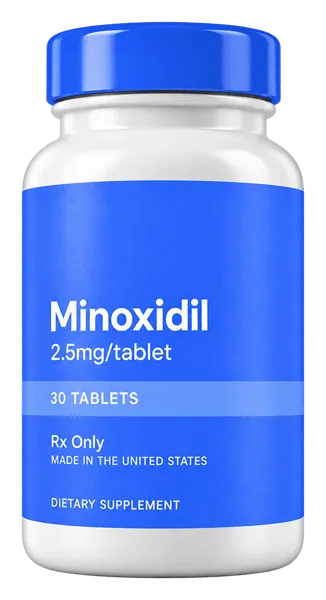
Topical minoxidil is sold over the counter without a prescription, while oral minoxidil requires a prescription and is priced by whoever dispenses it. As one dated reference point, Bodybuilding Peptides listed its 2.5 mg oral minoxidil tablet at $99 for a one-month plan when we checked on October 12, 2026, falling to a per-month $89 on a three-month plan, $79 on six months and $69 on twelve. A 2022 New York Times headline described the old pill as growing hair for “pennies a day” (Desir et al., 2024). Prices change, so treat these as a snapshot, and remember that the cost of a doctor visit or online consultation sits on top of any prescription.
Why are the forums split on oral vs topical minoxidil?
We cannot measure the forum split directly: our community tracker does not yet have a minoxidil dataset, so this section quotes no posts and makes no claims about what forum users say. What the research does show is why the question stays open. Interest in the pill jumped after the August 18, 2022 New York Times article “An Old Medicine Grows New Hair for Pennies a Day, Doctors Say,” and a Google Trends analysis found searches for oral minoxidil rose significantly and stayed up (Desir et al., Skin Appendage Disord, 2024). The trial results are also close enough that each side of the debate has a real data point:
- Efficacy. The 2024 trial’s blinded photo assessment favored oral at the crown, but its main density measure showed no significant difference and the meta-analysis found none.
- Topical drawbacks. Twice-daily application, hair texture changes and scalp irritation are documented reasons patients struggle with topical minoxidil (Randolph & Tosti, 2021).
- Oral drawbacks. Excess body and facial hair is the most common oral side effect, roughly double the topical rate in pooled trials.
- Non-response and early stopping. Response varies by person, and in one survey people who quit topical minoxidil stopped after a median of 3.5 months, most often because they saw no improvement. The overlapping question of when topical makes sense versus a prescription product is one we cover for skin peptides in topical vs prescribed skin peptides, and the copper-peptide serums that often show up in the same threads are covered in do copper peptides help hair growth.
Can you use oral and topical minoxidil together?
The head-to-head trials cited here tested each form alone, so they say nothing about using both at once. In the 2024 trial, each group received an active form plus a placebo of the other, which was designed to compare them, not to test the combination (Penha et al., 2024). Using both would also mean exposure to the side effects of each. Anyone weighing that should discuss it with a prescriber rather than rely on forum regimens.
The bottom line on oral vs topical minoxidil
Pick on trade-offs, not on hype: the randomized evidence says the two forms grow similar amounts of hair. Topical is over the counter and keeps side effects on the scalp, but asks for a daily routine that many people abandon. Oral is easier to take and spares the scalp, but it needs a prescription and brings more unwanted body hair and a small risk of blood-pressure and fluid effects. The trial authors’ own conclusion is a fair summary: oral is “an option for patients who prefer oral therapy or are intolerant to topical treatment.”
Status (oral minoxidil): Active ingredient is FDA-approved; compounded versions are not FDA-approved, and use for hair loss is off-label. What these status terms mean.
Sources and further reading
- Penha MA, Miot HA, Kasprzak M, Ramos PM. Oral Minoxidil vs Topical Minoxidil for Male Androgenetic Alopecia: A Randomized Clinical Trial. JAMA Dermatol. 2024;160(6):600-605
- Sobral MVS, et al. Efficacy and safety of oral minoxidil versus topical solution in androgenetic alopecia: a meta-analysis of randomized clinical trials. Int J Dermatol. 2025;64(3):479-484
- Ramos PM, Sinclair RD, Kasprzak M, Miot HA. Minoxidil 1 mg oral versus minoxidil 5% topical solution for the treatment of female-pattern hair loss: A randomized clinical trial. J Am Acad Dermatol. 2020;82(1):252-253
- Vañó-Galván S, et al. Safety of low-dose oral minoxidil for hair loss: A multicenter study of 1404 patients. J Am Acad Dermatol. 2021;84(6):1644-1651
- Randolph M, Tosti A. Oral minoxidil treatment for hair loss: A review of efficacy and safety. J Am Acad Dermatol. 2021;84(3):737-746
- Junge A, et al. Contact Dermatitis Caused by Topical Minoxidil: Allergy or Just Irritation. Acta Derm Venereol. 2025;105:adv42401
- Kiratiwongwan R, Boonchai W, Kanokrungsee S. Allergic Contact Dermatitis to Topical Preparations Containing Minoxidil: A Systematic Review and Individual Participant Data Meta-Analysis. Dermatitis. 2025;36(3):200-206
- Senthilnathan A, et al. Topical Minoxidil Adherence in Patients With Alopecia. J Drugs Dermatol. 2023;22(3):252-255
- Desir N, Desai AD, Lipner SR. Increased Interest in Oral Minoxidil for Hair Loss Treatment Following Publication of August 2022 New York Times Article: A Google Trends Analysis. Skin Appendage Disord. 2024;10(1):46-49
- Jimenez-Cauhe J, et al. Hair follicle sulfotransferase activity and effectiveness of oral minoxidil in androgenetic alopecia. J Cosmet Dermatol. 2024;23(11):3767-3773
- Minoxidil tablets, prescribing information (boxed warning, adverse reactions). DailyMed
- Men’s Rogaine Extra Strength (minoxidil 5% topical solution), Drug Facts label. DailyMed
- Women’s Rogaine (minoxidil 5% topical foam), Drug Facts label. DailyMed
Educational information only, not medical advice. Every clinical statement on this page traces to the sources above. Updated October 12, 2026.
Advertising disclosure: links marked "Paid link" go to Bodybuilding Peptides (trybbpeptides.com), an affiliate destination, and Complexion Science may earn a commission if you buy there. Our coverage is independent of that relationship, and nothing on this page is medical or legal advice.
 See it at Bodybuilding Peptides