Topical vs prescribed skin peptides: what's the real difference?

The short answer
Topical copper peptides (GHK-Cu) are cosmetic serums and creams you apply yourself, and they have the human evidence: small trials report modest gains in the look of firmness, fine lines and clarity. Injectable GHK-Cu has animal data but no published human trials, so its benefits and side effects in people are largely unmeasured. If you want the best-evidenced prescribed skin active, that is a retinoid such as tretinoin, not a copper peptide.
“Topical or prescribed?” is a natural question to ask about copper peptides, because a lot of skincare talk hints that there is a stronger version waiting behind a syringe or a prescription. The honest answer is more interesting than the pitch. For copper peptides (GHK-Cu), the topical serum is the version with human evidence behind it, while the injectable version rests on animal studies and online anecdotes. This page lays out what genuinely differs between a topical cosmetic peptide and an injectable or prescribed one, across four dimensions: what it is, evidence, delivery, and oversight. For the deeper single-ingredient background, our guide to GHK-Cu for skin and collagen goes further on the copper-peptide science, and copper peptides vs retinol weighs GHK-Cu against the best-evidenced anti-aging active.
What is the difference between topical and prescribed skin peptides?
A topical copper peptide is a cosmetic you apply yourself; an injectable or prescribed peptide is a drug-style product that goes into the body, usually with a provider involved. That single distinction drives everything else. The table maps the two across the dimensions that matter most, and each row is expanded and sourced below.
| Dimension | Topical copper peptide (GHK-Cu) | Injectable or prescribed skin peptide |
|---|---|---|
| What it is | A cosmetic ingredient in serums and creams; not reviewed by the FDA before sale | A product injected or prescribed for an individual patient |
| Human evidence (skin) | Small human trials of creams (skin firmness, fine lines, clarity) | For injected GHK-Cu, no published human trials; animal studies only |
| Delivery | A cream, serum, or lotion you apply to the skin | Typically an injection, or a preparation made to order |
| Oversight | You buy and use it yourself; no prescriber required | A licensed provider and, for compounded forms, a pharmacy are in the loop |
| Best-evidenced option | Topical GHK-Cu, for a gentle cosmetic active | A prescription retinoid such as tretinoin, which has decades of photoaging data |
What does “topical cosmetic GHK-Cu” actually mean?
Topical GHK-Cu is a skincare ingredient, and it is the form most people use. GHK-Cu is a small copper-binding tripeptide (glycine-histidine-lysine plus a copper ion) that occurs naturally in human plasma and declines with age, and it “can penetrate the stratum corneum, which ensures its activity in cosmetic formulations,” which is why “it is currently widely used in skin and hair products” (Pickart & Margolina, Int J Mol Sci 2018). In the lab it is reported to stimulate “collagen, dermatan sulfate, chondroitin sulfate, and a small proteoglycan, decorin” in skin fibroblasts (Pickart, Vasquez-Soltero & Margolina, BioMed Research International 2015).
Because it is sold as a cosmetic, no over-the-counter copper-peptide serum carries FDA approval, and it does not need to: cosmetics and their ingredients are not subject to FDA premarket approval (Congressional Research Service, MoCRA overview, 2023; FDA, “FDA Authority Over Cosmetics”). What keeps it a cosmetic is the claim: improving the appearance of skin, not treating a disease. So a topical copper peptide is best judged as a cosmetic with promising but limited evidence.
What does “prescribed” mean for skin peptides?
“Prescribed” covers two quite different things in skin care. The first is injectable GHK-Cu, which people discuss as a stronger version of the serum: the reasoning is that if a cream gets a little copper peptide through the skin, injecting it should deliver more. The second is the prescription skin actives that dermatologists already use every day, of which retinoids are the clearest example: tretinoin is a prescription-strength vitamin-A drug, and the over-the-counter form, retinol, is “20 times less potent than tretinoin and it requires further conversion to retinoic acid” to work (Mukherjee et al., Clin Interv Aging 2006).
Those two sit at opposite ends of the evidence scale. Prescription retinoids carry decades of clinical data for aging skin. Injectable GHK-Cu, by contrast, has no published human trials for skin, which the next section explains.
How does the evidence compare?
Topical GHK-Cu has small human trials; injected GHK-Cu has animal studies. On the topical side, the evidence is real but modest. The Pickart and Margolina review summarizes a study in which “a facial cream containing GHK-Cu applied for 12 weeks to the facial skin of 71 women with mild to advanced signs of photoaging increased skin density and thickness, reduced laxity, improved clarity, reduced fine lines and the depth of wrinkles” (Pickart & Margolina 2018). These are appearance studies of a cosmetic, and they are small.
On the injectable side, the same review describes GHK-Cu given systemically only in animals, such as mice, rats and pigs in wound-healing work (Pickart & Margolina 2018). A PubMed search we ran on October 12, 2026, filtered to clinical and randomized trials of injected GHK-Cu in people, returned no results. So there is no head-to-head “injection beats the cream” data to weigh, and before-and-after photos of injected GHK-Cu are anecdotes rather than trial outcomes. If your goal is the most evidence-backed active, that conversation points toward a retinoid, where prescription tretinoin carries decades of dermatology data for photoaging (Mukherjee et al. 2006).
What about side effects?
The side-effect picture follows the evidence. Topical copper peptides are described as gentle, with decades of cosmetic use and no consistently reported adverse effects (Pickart & Margolina 2018); the realistic risks are local irritation or an individual allergy, which a patch test catches. For injected GHK-Cu, there are no measured rates in people, so what circulates online, such as reports of poor sleep or restlessness, is forum anecdote that nobody has tested. Prescription retinoids have the opposite profile to copper peptides: strong evidence, but a well-known adjustment period of dryness and irritation (Mukherjee et al. 2006). Our page on whether GHK-Cu is safe goes deeper on tolerability and copper allergy.
Delivery and oversight: what changes when a provider is involved
Delivery and oversight are where “topical” and “prescribed” feel most different in daily life. A topical cosmetic is self-directed: you choose a serum, apply it, and no prescriber is required. A prescribed product adds two layers, a licensed provider who decides whether it is appropriate and, for compounded forms, a pharmacy that prepares it. That oversight is meaningful, but it does not create evidence that was never gathered: a provider can screen you and watch for problems, not tell you how well an untested injection works. Hair loss shows the same two layers with a drug that does have trial data: we walk through the intake, provider review and pharmacy steps in how oral minoxidil prescriptions work online, and compare the tablet with the scalp solution in oral vs topical minoxidil.
That is where talking to a provider earns its keep: an honest read on your skin, whether a topical peptide is worth adding, whether a prescription-strength option like a retinoid fits your skin and tolerance, and how to sequence actives without a flare. A consult is about your skin-aging concerns and what a provider recommends for them, never an assured outcome. For how copper peptides stack up against the best-evidenced anti-aging active, see copper peptides vs retinol, and for the fuller ingredient science, our guide to GHK-Cu for skin.
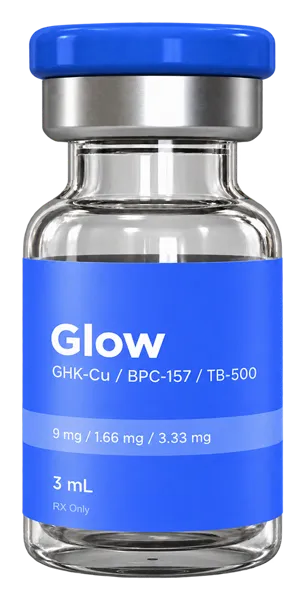
Status (injectable GHK-Cu): Not FDA-approved; sold by some telehealth providers as a compounded prescription. What these status terms mean.
Sources
Every ingredient claim, figure, and evidence statement on this page traces to a primary source, listed here so you can verify each one directly.
- Pickart L, Margolina A. Regenerative and Protective Actions of the GHK-Cu Peptide in the Light of the New Gene Data, International Journal of Molecular Sciences 2018 (PMC), GHK-Cu as a naturally occurring copper-binding tripeptide, its stratum-corneum penetration and cosmetic use, the 71-woman 12-week facial-cream study, and systemic GHK-Cu studies in animals.
- Pickart L, Vasquez-Soltero JM, Margolina A. GHK Peptide as a Natural Modulator of Multiple Cellular Pathways in Skin Regeneration, BioMed Research International 2015 (PMC), GHK-Cu stimulation of collagen, dermatan and chondroitin sulfate, and decorin in skin fibroblasts.
- Mukherjee S, Date A, Patravale V, et al. Retinoids in the treatment of skin aging: an overview of clinical efficacy and safety, Clinical Interventions in Aging 2006 (PMC), retinol being roughly 20 times less potent than prescription tretinoin, and the depth of the retinoid photoaging evidence.
- Congressional Research Service. FDA Regulation of Cosmetics and Personal Care Products Under the Modernization of Cosmetics Regulation Act of 2022 (MoCRA). Report R47826, cosmetics and their ingredients are not subject to FDA premarket approval.
- U.S. Food & Drug Administration. FDA Authority Over Cosmetics: How Cosmetics Are Not FDA-Approved, but Are FDA-Regulated, the cosmetic-vs-drug claim line and the absence of premarket approval for cosmetics.
Educational information about skincare ingredients only, not medical advice. Every ingredient and safety statement is sourced above; reviewed October 12, 2026.
Advertising disclosure: links marked "Paid link" go to Bodybuilding Peptides (trybbpeptides.com), an affiliate destination, and Complexion Science may earn a commission if you buy there. Our coverage is independent of that relationship, and nothing on this page is medical or legal advice.
 See it at Bodybuilding Peptides