Is GHK-Cu legal? The HHS draft peptide policy and why injectable GHK-Cu, GLOW, KLOW and Melanotan II are not covered
The short answer
No skin-trend injectable made the list. A draft HHS policy filed October 28, 2026 names six peptides HHS does not intend to act against when a licensed pharmacy or physician compounds one of them alone, under strict conditions. Injectable GHK-Cu and Melanotan II are not among the six, and the GLOW and KLOW blends fail the single-ingredient condition, so their status did not change. Topical copper peptide skincare is a separate category the draft does not address.
Key takeaways
- A draft HHS policy filed October 28, 2026 names six peptides HHS does not intend to act against when one is compounded alone under strict conditions: BPC-157, epitalon, KPV, MOTS-c, semax and TB-500.
- Injectable GHK-Cu and Melanotan II are not among the six, so their status did not change, and both remain not FDA-approved.
- The GLOW and KLOW blends fail the draft's single-ingredient condition, and GHK-Cu inside them is not on the list either.
- The draft is about compounding drug products, so it does not address copper peptide serums and creams sold as skincare.
- It is a statement about enforcement, not an approval: compounded drugs are not FDA-approved, and state rules still apply.
News, filed October 28, 2026
This page covers a draft federal policy filed for public inspection on October 28, 2026, with Federal Register publication scheduled for October 30, 2026. We will update it when the Federal Register posts the notice and its comment deadline. Educational information and commentary only, not medical or legal advice.
In short: the federal peptide news of October 28 skipped the peptides this site writes about most. A draft HHS policy names six peptides that HHS does not intend to take enforcement action over when a licensed pharmacy, federal facility or licensed physician compounds one of them alone, under a long list of conditions.
Injectable GHK-Cu is not one of the six. Melanotan II is not one of the six. And the GLOW and KLOW blends, the injectable blends that put GHK-Cu in a vial, fail the draft’s single-ingredient condition even though some of their parts are on the list. For skin readers, the honest headline is “nothing changed for us,” and this page explains why.
For the full policy, all six peptides and every condition, read the hub explainer, HHS’s draft peptide compounding policy, explained.
What did HHS file on October 28, 2026?
HHS filed a notice announcing “the availability of a draft” policy titled “Enforcement Discretion Policy Regarding 503A Compounding Using Certain Peptide Bulk Drug Substances” (Federal Register public inspection copy, FR Doc. 2026-22192). It was filed at 11:15 am on October 28, Federal Register publication is scheduled for October 30, and it was signed by HHS Secretary Robert F. Kennedy, Jr. It comes from the HHS Secretary, not from FDA.
The notice says the policy “does not establish any rights for any person and is not binding on HHS or the public,” and that HHS “may revisit application of this interim policy (in whole or in part) if, among other things, a safety signal or product quality issue arises.”
The core sentence is narrow. HHS “does not intend to take enforcement action against a State-licensed pharmacy, Federal facility, or licensed physician compounding a drug product” using one of the peptides in its Appendix A, when every condition is met (HHS policy and appendices). Appendix A lists exactly six: BPC-157, epitalon, KPV, MOTS-c, semax and TB-500. It is a statement about enforcement, not an approval, and it adds nothing to the 503A bulks list.
Skin peptides and the draft at a glance
| Product | In the draft’s six? | Where it stands after October 28 |
|---|---|---|
| Injectable GHK-Cu | No | Not FDA-approved; status did not change |
| Topical copper peptide serums and creams | Not addressed (skincare, not compounding) | A cosmetic ingredient, as before |
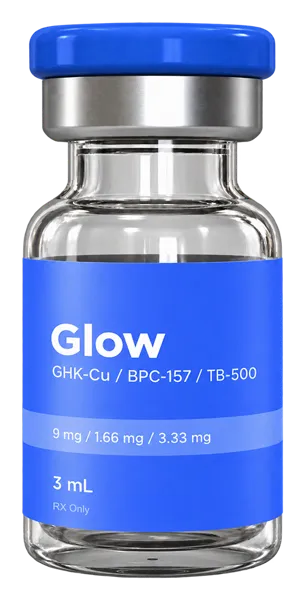
| GLOW blend (GHK-Cu, BPC-157, TB-500) | No; fails the single-ingredient condition | Not FDA-approved; not covered |
| KLOW blend (GLOW plus KPV) | No; fails the single-ingredient condition | Not FDA-approved; not covered |
| Melanotan II | No | Not FDA-approved for any use; status did not change |
| BPC-157, TB-500 or KPV, each alone | Yes, with route limits | Not FDA-approved; covered only when compounded alone under the draft’s conditions |
Is GHK-Cu covered by the HHS peptide policy?
No. Injectable GHK-Cu is not one of the six peptides in Appendix A, so its status did not change. The draft does not name GHK-Cu at all; it is left out by omission, the same way CJC-1295, ipamorelin, selank, LL-37 and several others are (HHS policy, Appendix A). Injectable GHK-Cu remains not FDA-approved.
That matters because the safety questions about injecting copper peptides are untouched, and nothing in the October draft addresses them.
The evidence picture is unchanged too: injected GHK-Cu has animal studies and no published human trials, as our explainer on GHK-Cu peptide injections sets out.
Does the HHS policy change anything for my copper peptide serum?
Our read: no. The draft is about pharmacies and physicians compounding drug products from bulk drug substances, under section 503A (Federal Register notice). A copper peptide serum or cream bought as skincare is not what it addresses, and GHK-Cu is not on its list in any form.
That leaves topical GHK-Cu where it was: a long-used cosmetic ingredient backed by small, mostly industry-linked human studies that report modest changes in firmness, fine lines and skin density over about 12 weeks (Pickart et al., 2015).
If anything, the news is a useful reminder of the gap this site keeps pointing to. The only route for copper peptides with human skin data is the one that never needed a federal policy: the jar. Our guide to GHK-Cu copper peptides for skin covers that evidence in full.
Are the GLOW and KLOW blends covered by the HHS peptide policy?
No. One of the draft’s conditions is that “the compounded drug product contains only a single Active Pharmaceutical Ingredient (API) listed in Appendix A” (HHS policy, Interim Policy). A blend has more than one active ingredient by definition, so it cannot meet that condition.
The policy documents do not name GLOW or KLOW; applying the single-ingredient condition to them is our reading, and it is not a close call. GLOW is GHK-Cu plus BPC-157 plus TB-500. KLOW is the same three plus KPV (The New Yorker, 2026).
Each blend fails twice over: it contains more than one active ingredient, and one of those ingredients, GHK-Cu, is not one of the six. Neither blend is FDA-approved, and neither has been studied as a combination. Our KLOW vs Glow comparison goes through the evidence for each component.
If BPC-157 and TB-500 are covered, why is GLOW not covered?
Because the draft covers a peptide only when it is compounded on its own. BPC-157 and TB-500 are both in Appendix A, with route limits: BPC-157 for subcutaneous, intramuscular, oral and topical forms, and TB-500 for subcutaneous or intramuscular injection (HHS policy, Appendix B). Put them in one vial with GHK-Cu and the product is no longer a single-ingredient compound, so the draft does not reach it.
This is where online stacking habits and the policy point in opposite directions. In the X posts our community tracker collected in July 2026, GHK-Cu showed up as one line item in bigger stacks: in 19 MOTS-c posts collected July 16 to 19, users described combining MOTS-c with items such as NAD+, GHK-Cu and GLP peptides, and in 8 KPV posts collected July 18 to 20, users described stacking KPV with BPC-157, TB-500 and GHK.
Those are a small number of unverified self-reports, and they are not posts about GLOW or KLOW specifically, but in them peptides were usually combined rather than used alone. The draft is built around the opposite idea, one documented ingredient per product.
Is KPV covered, and does that help KLOW?
KPV is one of the six, but only for topical and oral forms: Appendix B describes it as “appropriate for topical and oral dosage forms” (HHS policy, Appendix B). Oral forms carry an extra condition: documentation “confirming that the specific formulation provided to a patient achieves an adequate level of oral bioavailability in humans.”
So KPV’s place on the list does not help KLOW. KLOW is sold mostly as an injectable blend, and KPV inside it is neither alone nor in a covered route.
KPV is still not FDA-approved, and its evidence base is still cell and animal studies, mostly on gut inflammation, with a few skin-cell experiments and no human trials, as our KLOW peptide explainer describes. The topical route is the skin-relevant detail worth noticing, but a covered route is not evidence that something works on skin.
Is Melanotan II covered by the HHS peptide policy?
No. Melanotan II is not one of the six peptides in Appendix A, so its status did not change (HHS policy, Appendix A). It remains not FDA-approved for any use.
The skin concerns are exactly where they were. In July 2026 the Skin Cancer Foundation warned that the safety of Melanotan II has not been established and advised people seeking a tan to avoid injectable or intranasal tanning drugs (Skin Cancer Foundation, 2026). A 2017 dermatology review describes increasing numbers of case reports linking unregulated melanotan use to changes in existing moles and new, sometimes atypical, moles (Habbema et al., 2017).
A federal compounding policy that leaves Melanotan II out does nothing to that record. Our page on whether Melanotan is safe for tanning covers the moles, the melanoma case reports and the nasal sprays in detail.
Does the HHS policy mean any skin peptide is FDA-approved?
No. Both documents say it plainly: “Compounded drugs are not FDA-approved, which means FDA does not review their safety, effectiveness, or quality before they are marketed” (Federal Register notice; HHS policy). That applies to the six covered peptides, and it applies even more obviously to injectable GHK-Cu, the blends and Melanotan II, which the draft does not cover at all.
The draft’s own appendix also shows how contested the six were. For every one of them, Appendix B records that FDA’s drug center recommended against listing and the Pharmacy Compounding Advisory Committee voted in favor. HHS issued the draft regardless, saying the policy “advances patient choice and freedom while appropriately protecting patient safety.”
Critics quoted in the press disagree sharply: Robert Steinbrook of Public Citizen told NPR the move “undermined the FDA,” and Peter Lurie of the Center for Science in the Public Interest told NBC that FDA was “turning a blind eye” (NPR, 2026; NBC News, 2026). Supporters such as Lee Rosebush of the American Academy of Peptide Medicine called it a “landmark regulatory milestone” (Reuters, 2026). None of that debate touches the skin peptides, which were never on the list.
When does the HHS peptide policy take effect?
The documents give no date beyond the filing (October 28, 2026) and scheduled Federal Register publication (October 30, 2026). Written comments can be submitted “until 2 weeks after date of publication in the Federal Register” on regulations.gov, Docket No. HHS-OASH-2026-0496 (Federal Register notice); we will add the exact deadline once the published notice shows its date.
The policy is meant to run until each covered peptide is addressed in a final rulemaking on the 503A bulks list, and it may be revisited if a safety signal or product quality issue arises.
For the skin peptides, timing is beside the point. Whenever the draft is treated as in effect, injectable GHK-Cu, GLOW, KLOW and Melanotan II remain outside it.
What does the draft mean for people who were looking at GLOW, KLOW or injectable GHK-Cu?
In practical terms, nothing about these products changed on October 28. The same questions that applied the day before still apply:
- Is the vial what the label says? TIME reported that at least 20% of unapproved peptides tested by the drug-testing company BTLabs were mislabeled, and the company’s co-founder gave the example of a vial labeled Glow that was actually Klow, or the reverse (TIME, 2026). The draft’s testing and manufacturer conditions apply only to the six covered peptides, compounded alone.
- Has anyone measured the result? No published human trial has tested injected GHK-Cu, GLOW or KLOW. Dermatologists told NPR they are advising patients to hold off on injecting until human studies are done (NPR, 2026).
- What do your state’s rules say? State rules still apply and vary; the federal draft does not change them. In Mississippi, for example, the nursing, pharmacy and medical boards jointly stated in August 2026 that “Under no circumstances is it permissible for a healthcare provider to compound, administer, or dispense a non-FDA approved or research-grade peptide to a patient” (Mississippi joint statement, 2026).
The draft also does not cover research-use-only products; HHS frames the policy as an alternative to them and says they “pose a safety risk to US patients.”
For skin goals specifically, the route with human data is still topical copper peptides, and the person to talk to about anything injectable is a licensed clinician who can look at your own skin and history. Our guide to building a peptide skin routine safely starts there.
What is still unknown?
- Whether and how the draft changes, and when it is treated as in effect.
- The exact comment deadline, which depends on the actual publication date.
- Whether any peptide left out of Appendix A, GHK-Cu included, gets a later review. The draft says nothing on that.
- How state boards respond to the federal draft.
- Any HHS or FDA position on 503B outsourcing facilities, which are not among the covered entities.
Status
Injectable GHK-Cu: Not FDA-approved. Injectable GHK-Cu is not one of the six peptides in the draft HHS compounding policy filed Oct 28, 2026; its status did not change. GLOW blend (GHK-Cu, BPC-157, TB-500): Not FDA-approved. The draft HHS policy filed Oct 28, 2026 covers single-ingredient products only, and GHK-Cu is not one of its six. Not covered. KLOW blend (GLOW plus KPV): Not FDA-approved. The draft HHS policy filed Oct 28, 2026 covers single-ingredient products only, and GHK-Cu is not one of its six. Not covered. Melanotan II: Not FDA-approved for any use. Not one of the six peptides in the draft HHS compounding policy filed Oct 28, 2026; its status did not change. What these status terms mean.
Frequently asked questions
Is GHK-Cu legal?
It depends on the form, and this page is commentary, not legal advice. Topical GHK-Cu is a long-used cosmetic ingredient in serums and creams, which the October 2026 HHS draft does not address. Injectable GHK-Cu is not FDA-approved and is not one of the six peptides in the draft HHS compounding policy filed Oct 28, 2026, so its status did not change; state rules also vary.
Is GHK-Cu FDA approved?
No. Injectable GHK-Cu is not FDA-approved, and FDA's safety summary flags possible immune reactions from aggregation and peptide-related impurities, with limited human data. Copper peptide skincare is sold as a cosmetic rather than an approved drug. The hub GHK-Cu overview covers the molecule across every route.
Are peptides FDA approved?
The peptides in the October 2026 draft are not. Both the Federal Register notice and the HHS policy state that compounded drugs are not FDA-approved, which means FDA does not review their safety, effectiveness or quality before they are marketed. For the full policy and all six peptides, see the hub explainer on HHS's draft peptide compounding policy.
Are GLOW and KLOW covered by the HHS peptide policy?
No. The draft covers a compounded product only when it contains a single active ingredient listed in its Appendix A, and a blend has more than one by definition. GLOW (GHK-Cu, BPC-157, TB-500) and KLOW (the same three plus KPV) also contain GHK-Cu, which is not one of the six.
Sources and further reading
- Federal Register public inspection copy. Enforcement Discretion Policy Regarding 503A Compounding Using Certain Peptide Bulk Drug Substances; Notice of Availability. FR Doc. 2026-22192, Docket No. HHS-OASH-2026-0496. Filed October 28, 2026
- Federal Register document page for FR Doc. 2026-22192 (live after publication)
- U.S. Department of Health and Human Services. HHS 503A peptide enforcement discretion policy, with Appendix A and Appendix B
- The Treatment Report. HHS’s draft peptide compounding policy, explained
- U.S. Food and Drug Administration. Certain Bulk Drug Substances for Use in Compounding that May Present Significant Safety Risks (GHK-Cu, injectable routes)
- Pickart L, Vasquez-Soltero JM, Margolina A. GHK Peptide as a Natural Modulator of Multiple Cellular Pathways in Skin Regeneration. BioMed Research International, 2015;2015:648108
- Habbema L, Halk AB, Neumann M, Bergman W. Risks of unregulated use of alpha-melanocyte-stimulating hormone analogues: a review. Int J Dermatol. 2017
- The Skin Cancer Foundation. The Skin Cancer Foundation Issues Warning Regarding Melanotan II. July 7, 2026
- Mississippi Board of Nursing, Board of Pharmacy and State Board of Medical Licensure. Joint statement on peptides, August 19, 2026
- Stone W. The copper peptide trend has gone from creams to injections, ahead of the science. NPR, September 7, 2026
- Mosbergen D. What to Know About the “Anti-Aging” Peptide Shots Flooding Social Media. TIME, February 24, 2026
- Khullar D. Why Are People Injecting Themselves with Peptides? The New Yorker, April 13, 2026 issue
- NPR. Report on the HHS peptide compounding enforcement policy, October 28, 2026
- NBC News. Report on the HHS peptide policy, October 28, 2026
- Reuters. Report on the HHS peptide policy, October 28, 2026
Educational information and commentary only, not medical or legal advice. Not reviewed by an attorney. Policy facts come from the Federal Register public inspection copy and the HHS policy PDF as of October 28, 2026. Community observations come from our July 2026 X post collections for MOTS-c and KPV. Published October 28, 2026.
About the editorial team
Advertising disclosure: links marked "Paid link" go to Bodybuilding Peptides (trybbpeptides.com), an affiliate destination, and Complexion Science may earn a commission if you buy there. Our coverage is independent of that relationship, and nothing on this page is medical or legal advice.
 See it at Bodybuilding Peptides